
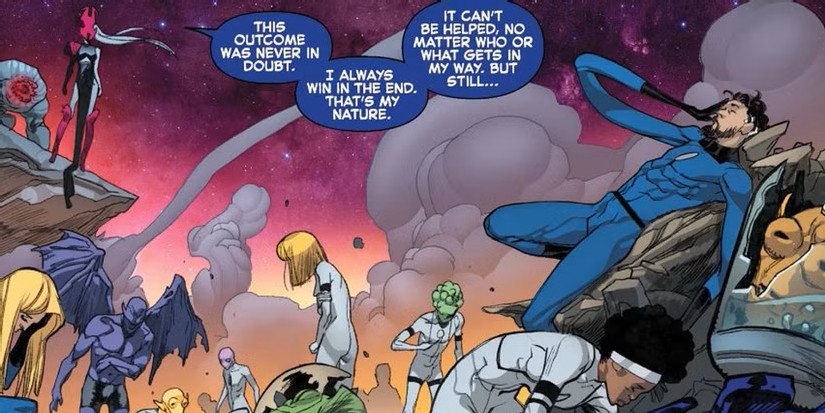
In our previous article, we explored why the Fantastic Four are known as Marvel’s First Family. The title isn’t just a reflection of their place in comic book history as Marvel’s first superhero team of the modern age. It’s something they earned through decades of shared adventures, personal growth, sacrifice, and relationships that allowed them to become a family in ways few superhero teams ever have.
When Marvel relaunched Fantastic Four in 2018 under writer Dan Slott, he didn’t leave that idea behind. Instead, he made it the foundation of his new series. After more than two years without their own comic, Marvel’s First Family returned with a mystery that had been building since the conclusion of Secret Wars. Where had Reed Richards, Sue Storm, Franklin Richards, and Valeria Richards been, and what mission had kept them away for so long?
The answers would lead to a confrontation with the Griever at the End of All Things, one of Marvel’s newest and most intriguing cosmic entities. More importantly, the battle that followed would test not only Reed Richards’ brilliant mind, but also the very idea of what it means to be Marvel’s First Family. By the time the story ended, Dan Slott had shown that the Fantastic Four’s greatest strength had never been their superpowers—it was the family they had become.
To understand how the Fantastic Four defeated the Griever, we first need to understand what Marvel’s First Family had been doing since Secret Wars.
The Return of Marvel’s First Family
The story begins with one of Marvel’s most important crossover events. Published in 2015, Secret Wars was written by Jonathan Hickman with artwork by Esad Ribić. The nine-issue series brought together years of storylines from Avengers and New Avengers, culminating in the destruction of the Marvel multiverse and bringing Hickman’s epic saga to its conclusion.
With every universe destroyed, Doctor Doom used the stolen power of the Beyonders to create Battleworld, a patchwork world assembled from the remnants of countless realities. In the climactic battle, Reed Richards confronted Doom not only physically but philosophically. Even Doom admitted that Reed would have made a better god. Instead of ruling creation, Reed chose to restore it. After Molecule Man transferred the Beyonders’ power to him, Reed, Sue Storm, Franklin Richards, Valeria Richards, and the Future Foundation remained behind to rebuild the multiverse, with Franklin creating new universes and Reed helping shape them into reality.
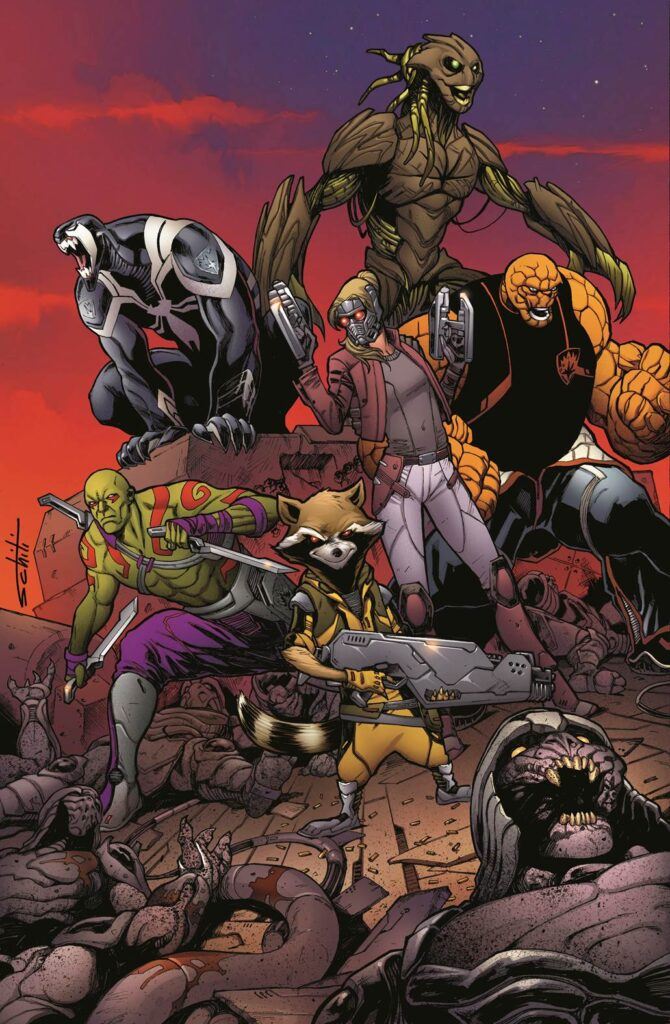
For Reed, the mission meant more than restoring what had been lost. His scientific pursuits had often come at the expense of time with his family. Rebuilding the multiverse gave him something he had rarely allowed himself—years spent alongside Sue, raising Franklin and Valeria, and sharing that extraordinary journey with the Future Foundation. It was a chance to rebuild creation while strengthening the family at the heart of the Fantastic Four.
Meanwhile, readers experienced a different kind of absence. Following Secret Wars, Marvel ended the Fantastic Four series, leaving comic shop shelves without the team’s flagship title for more than two years. The characters hadn’t disappeared from Marvel Comics entirely. Ben Grimm continued his adventures with the Guardians of the Galaxy, while Johnny Storm became a member of the Inhumans. Reed, Sue, Franklin, Valeria, and the Future Foundation, however, remained missing.
Dan Slott finally answered that mystery when he relaunched Fantastic Four in 2018. But their work rebuilding creation had attracted the attention of a powerful new cosmic entity whose purpose stood in opposition to everything they were doing: the Griever at the End of All Things.
Who Is the Griever at the End of All Things?
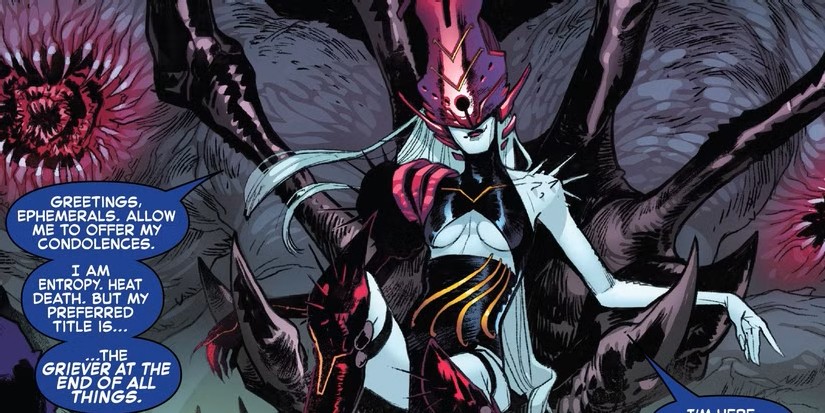
Throughout their history, the Fantastic Four have faced some of Marvel’s most powerful cosmic beings. They have battled Galactus, encountered the Watcher, and even defended Galactus during the famous Trial of Reed Richards. As we’ve seen in our previous look at the Fantastic Four’s cosmic encounters, these beings aren’t always villains in the traditional sense. Some represent fundamental forces of the Marvel Universe beyond ordinary concepts of good and evil.
The Griever at the End of All Things belongs in that category. Introduced by writer Dan Slott and artist Sara Pichelli in Fantastic Four (Vol. 6) #2 in 2018, the Griever is a cosmic abstract associated with entropy and the eventual heat death of the universe. Her purpose is contained in her name: everything that begins must eventually come to an end. Stars die. Universes cease to exist. Even creation itself cannot continue forever.
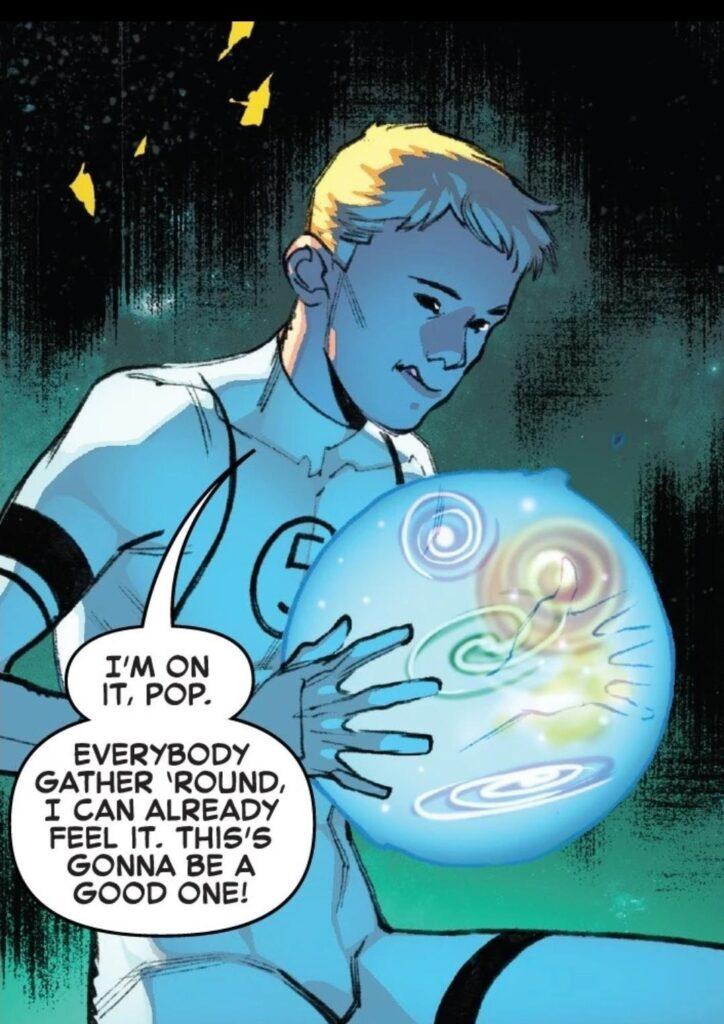
That philosophy put her directly at odds with Reed Richards, Franklin Richards, and the Future Foundation. After Secret Wars, Franklin had been creating new universes while Reed helped shape them, effectively rebuilding a multiverse that had already come to an end. To the Griever, their seemingly endless creation interfered with the natural order she represented.
The Griever did not attack immediately. She waited as Franklin continued creating universes and depleted the extraordinary power he had been using to make them. Only after his abilities had significantly diminished did she make her move, threatening the very universes the family had spent years rebuilding.
She also demonstrated the magnitude of the threat by turning her attention to Owen Reece, the Molecule Man, whose tremendous power had been essential to Franklin’s creation of new universes. The Griever utterly destroyed Owen’s physical body, seemingly eliminating one of the most powerful beings in existence.
But Owen wasn’t completely gone. Before his destruction was complete, he managed to condense his essence and consciousness into a single molecule and send it deep into the multiverse, beyond the Griever’s reach. Reed and the others did not know where it had gone, leaving Owen’s fate uncertain.
For all her immense power, however, the Griever had limitations of her own. As an embodiment of entropy, she could destroy, but she could not create. More importantly, she could not simply travel wherever she wished throughout the multiverse. She depended upon technology to move between realities.
Franklin’s powers were nearly exhausted, Molecule Man was missing, and the Griever seemed unstoppable. But Reed Richards had spent a lifetime confronting impossible problems. And seemingly insignificant details had a way of becoming very important once Reed began putting the pieces together.
How Reed Richards Changed the Battle
Normally, I try not to give away every detail of a comic book battle. Part of the fun of reading these stories is discovering for yourself how the heroes overcome seemingly impossible odds. But The End of All Things is different. To understand why this story so perfectly demonstrates what it means to be Marvel’s First Family, we need to look more closely at how Reed Richards confronted the Griever—and that means revealing how the battle ends.
With Franklin’s powers nearly exhausted and Molecule Man missing, Reed Richards and the Future Foundation were running out of options. Reed needed help, and he asked the Griever for permission to summon the rest of the Fantastic Four.
The Griever agreed, apparently believing Reed meant only the two missing members of the original team—Ben Grimm and Johnny Storm.
But Reed Richards had a much broader definition of the Fantastic Four.
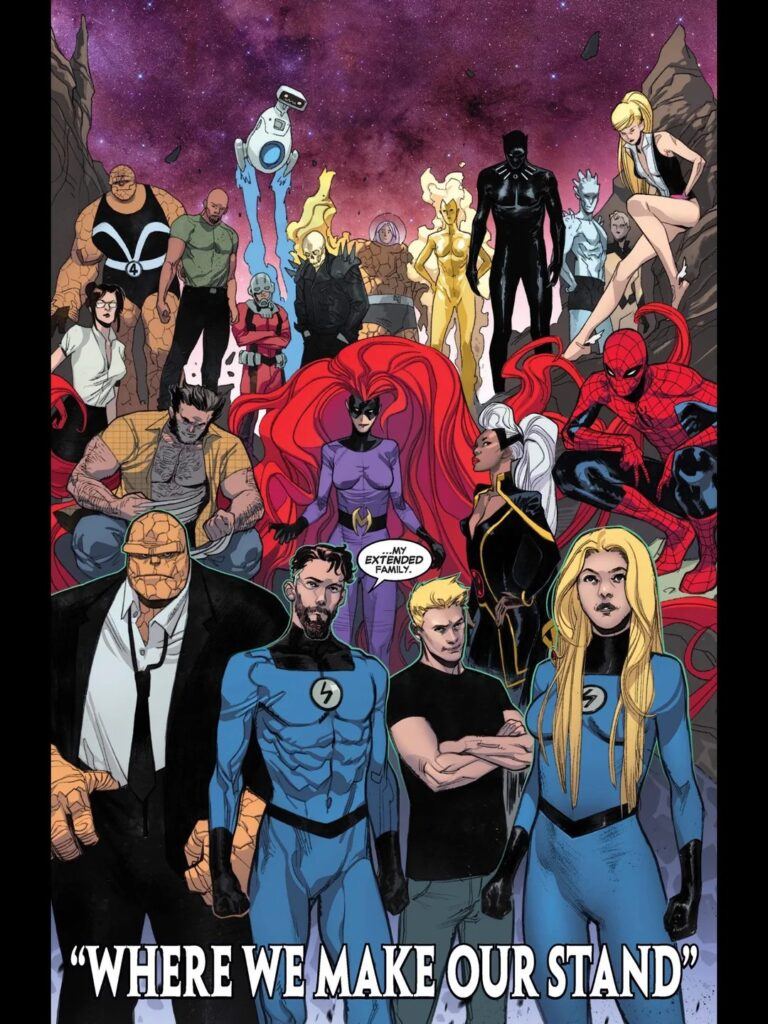
His signal reached across the Marvel Universe, summoning Ben and Johnny along with an extraordinary collection of heroes who had served as members of the Fantastic Four over the years. Spider-Man, She-Hulk, Wolverine, Ghost Rider, Crystal, Medusa, Luke Cage, Ant-Man, and others answered Reed’s call. What the Griever expected to be two additional heroes became a gathering drawn from decades of Fantastic Four history.
Even Iceman appeared, much to Johnny Storm’s annoyance. Johnny immediately questioned whether Bobby Drake had ever really been a member of the Fantastic Four. Slott would revisit that seemingly petty argument later in his run, when Johnny learned that Bobby really had served with the team during a time when Johnny himself had walked away. Eventually, Johnny accepted the lesson Reed already understood: being part of the Fantastic Four meant becoming part of the family.
But Reed wasn’t simply assembling enough superhuman power to overwhelm the Griever. Even as the battle raged, he gave his family specific instructions that didn’t necessarily seem aimed at defeating her.
One of those instructions went to Johnny.
Reed ordered the Human Torch to destroy the Telepods aboard the Griever’s ship until only one remained. As Johnny went after them, he received some unexpected help from another former member of the Fantastic Four—the Hulk. Hulk was keeping his presence hidden from the rest of the universe and wanted it to stay that way. After secretly carrying out Reed’s order, he told Johnny to keep his involvement quiet and allowed the Torch to take the credit.
Destroying the Telepods might have seemed like a relatively small accomplishment in a battle against a cosmic being capable of wiping out entire universes. But Reed rarely did anything without a reason.
As we have already seen, for all her incredible power, the Griever depended upon technology to travel between realities. Now only one Telepod remained.
Still, the assembled Fantastic Four family had not defeated her. Even with all the power Reed had brought together, the Griever remained an almost impossibly powerful opponent.
But Reed Richards was no longer trying to solve the problem everyone else thought they were solving.
The Fantastic Four didn’t necessarily have to find a way to overpower the Griever. Reed had begun to understand that there might be another way to win.
Why Only the Fantastic Four Could Have Won
Even with decades of Fantastic Four members fighting at his side, Reed Richards understood something that changed the entire battle: they couldn’t defeat the Griever.
Fortunately, they didn’t have to.
Reed realized that defeating the Griever had never really been the problem he needed to solve. The Fantastic Four only needed to make her stop what she was doing and leave. Once Reed changed the definition of victory, he could use what he had learned about the Griever against her.
That’s why Reed had ordered the destruction of all but one of her Telepods. For all her tremendous power, the Griever couldn’t move freely between realities without them. And as an embodiment of entropy, she could destroy, but she could not create.
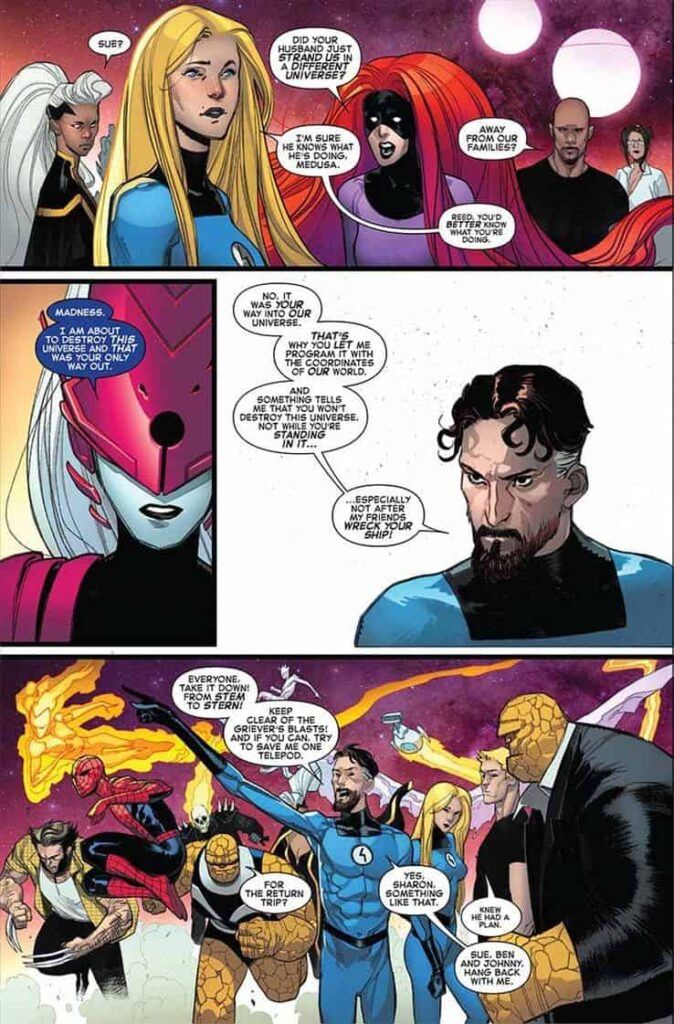
Reed confronted the Griever with the reality of her situation. If she continued the battle, he could destroy the final Telepod and strand her in that reality. She couldn’t create another one and would have no way to return to her own realm.
Suddenly, the Griever had a choice. She could continue fighting the enormous Fantastic Four family Reed had assembled and risk losing her only way home, or she could stop the battle and use the final Telepod to leave.
She chose to leave.
The Griever wasn’t destroyed, knocked unconscious, or imprisoned. In fact, she departed with a promise of vengeance. But Reed had accomplished exactly what the Fantastic Four needed. The attack was over, and the Griever had returned to her own realm.
It was a classic Reed Richards victory. Faced with an opponent the Fantastic Four couldn’t overpower, Reed stopped asking how they could defeat her and started asking what they actually needed to accomplish.
And he couldn’t have done it alone. His plan depended on the extraordinary family that had grown around the Fantastic Four over the decades—a family large enough to surprise even a cosmic entity at the end of all things.
The Griever thought Reed was asking for two more heroes.
What she got was a family.
A New Beginning for Marvel’s First Family
With the Griever gone, Reed Richards could finally turn his attention toward getting everyone home. The many heroes who had answered his call were returned to the places from which they had been summoned, but not everyone chose to go back to Earth.
Dragon Man and the Future Foundation remained behind. Although the Griever had destroyed Molecule Man’s physical body, Owen Reece had survived by reducing his essence to a single molecule and hiding it somewhere within the multiverse. The Future Foundation decided to continue searching for him, a mission that would later be explored in Marvel’s Future Foundation series in 2019.
For Reed, Sue, Franklin, and Valeria, however, the time had finally come to go home. Ben Grimm and Johnny Storm were once again beside them, and after years spent rebuilding the multiverse, the Fantastic Four were finally returning to Earth as a family.
Of course, coming home is rarely simple for the Fantastic Four.
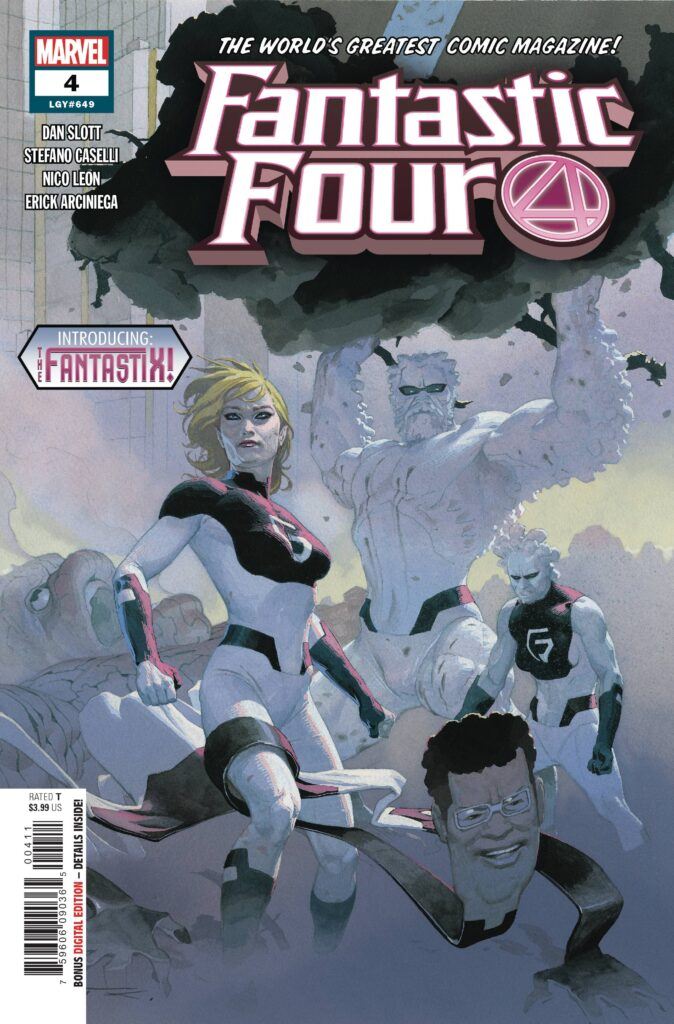
When they arrived, they discovered that things had changed during their absence—including a new superhero team called the Fantastix, who had taken up residence in the Fantastic Four’s former headquarters. After years spent creating universes and battling a cosmic embodiment of entropy, Marvel’s First Family returned home to discover that life on Earth had continued without them.
It was an appropriate beginning to Dan Slott’s new era. The End of All Things didn’t simply bring the Fantastic Four back together. Reed’s call demonstrated how much the family had grown over the decades to include children, friends, teammates, and heroes who had stood beside them when they were needed.
Dan Slott began his Fantastic Four run by bringing Marvel’s First Family home. In doing so, he reminded readers that their greatest strength wasn’t cosmic power, advanced technology, or even Reed Richards’ remarkable intellect.
It was—and always had been—family.
What Do You Think?
What did you think of Reed’s solution to the Griever? And did you enjoy seeing his definition of the Fantastic Four family extend to the many heroes who had served with the team over the years?
Did The End of All Things feel like a fitting way to bring Marvel’s First Family back together after their long absence? I’d love to hear your thoughts. Let me know in the comments below.
Suggested Comic Reading
If you’d like to experience these stories for yourself, here are the comics that provide the most important background and follow-up:
- Fantastic Four (Vol. 6) #1–4 (2018), written by Dan Slott — Start with the return of the Fantastic Four and follow the story through their confrontation with the Griever at the End of All Things.
- Secret Wars #1–9 (2015–2016), written by Jonathan Hickman — This Marvel crossover covers the destruction of the multiverse, Battleworld, Molecule Man’s role, and the events that led Reed and his family to begin rebuilding the multiverse.
- Future Foundation #1–5 (2019) — Follow Dragon Man and the Future Foundation as they continue their journey through the multiverse in search of Owen Reece, the Molecule Man.
Many of these stories can also be read digitally through Marvel Unlimited, Marvel’s subscription comic-reading service.
Continue Exploring the Fantastic Four
If you’d like to continue our journey through Fantastic Four history, you may also enjoy:
- Why Is the Fantastic Four Considered Marvel’s First Family? — Discover how Reed, Sue, Ben, and Johnny grew from four adventurers into one of Marvel’s most unusual families.
- The Fantastic Four’s Cosmic Encounters: Galactus and Beyond — Explore the team’s encounters with Galactus, the Silver Surfer, the Watcher, and other cosmic forces that helped define their place in the Marvel Universe.
- The Fantastic Four’s Greatest Villains: A Legacy of Conflict — Look back at the enemies who have challenged the Fantastic Four and why their greatest conflicts often involve more than simply defeating a villain.
And if you enjoyed this article, please use the share buttons to pass it along on your favorite social media site. You never know when another Fantastic Four fan might enjoy joining the conversation!
Hi, Scott, Reed’s solution lands because it treats the Griever like a cosmic problem to be redirected rather than a villain who simply needs a bigger punch. Leaving her one Telepod turned her dependence on technology into leverage, while the expanded Fantastic Four roster made the family theme feel earned rather than merely nostalgic.
I also think this was a fitting return for Marvel’s First Family, since it gave Reed’s intellect, Johnny’s action, and decades of shared connections a role in the win. The real flex was redefining victory as protecting the rebuilt multiverse and getting everyone home, which is very Fantastic Four.
Hi Aly,
I really like your point about Reed treating the Griever as a cosmic problem to be redirected rather than simply another villain who needed to be overpowered. That really is classic Reed Richards thinking. Once he realized they couldn’t defeat her in the conventional sense, he changed the definition of victory.
There is a darker side to that victory, though. By the time Reed and the expanded Fantastic Four stopped her, the Griever had already destroyed hundreds of the universes Franklin and Molecule Man had created. Marvel never gives us an exact death toll, but considering these were entire populated universes, the number of lives lost would be almost impossible to comprehend—potentially trillions upon trillions of beings.
That makes Reed’s solution even more important. He wasn’t undoing what the Griever had already done; he was preventing her from continuing until there was nothing left. And I agree that bringing together the extended Fantastic Four family was the perfect way to mark their return. They didn’t win because one member was powerful enough. They won because Reed had a plan, Johnny and the others could execute it, and the Fantastic Four had spent decades building relationships with people who answered when Reed called.
That combination of family, exploration, relationships, and Reed finding a solution nobody else sees is about as Fantastic Four as you can get. Thanks for another thoughtful comment!
Please keep coming back for more superhero fun! And, please share on social media!
– Scott
And as usual, Reed Richards demonstrates brain over brawn. They’ve done this sort of battle several times, as you’ve mentioned – this “Physical Reality Creates Inevitability” idea (which always makes me wonder if they don’t consult with some physicists at some point.) And the solution is always to use the brawn to convince the antagonist to choose something different. It’s almost like fighting god, right? Maybe that’s their whole idea, ultimately. At any rate, I do like these philosophical conundrums they dream up. Very well-worth reading.
Hi Don,
That’s a great way of putting it—brain over brawn has been one of Reed Richards’ trademarks from the beginning. And I think your comparison to “fighting god” is especially appropriate with the Griever. She isn’t really a conventional villain at all. She represents entropy and the inevitable end of things. How do you punch something like that into submission?
That’s one of the things I enjoy about the Fantastic Four’s cosmic stories. The physical battle is often necessary, but it isn’t necessarily what wins the day. Against the Griever, all that firepower—including the extended Fantastic Four family Reed summoned—couldn’t actually defeat her. What it could do was keep her occupied long enough for Reed to understand the problem and change the circumstances.
His solution with the Telepods is a perfect example. Reed didn’t prove that the Fantastic Four were stronger than the Griever. He created a situation in which continuing the fight was no longer in her best interest. In a sense, he didn’t defeat the Griever herself; he defeated the situation she had created.
And I’m with you on the philosophical side of these stories. Some of the best Fantastic Four adventures ask questions that are much bigger than “How do we beat the bad guy?” That’s a big part of what keeps me coming back to them.
Thanks, Don. I always enjoy the additional perspective you bring to these discussions!
– Scott
The Griever sounds like a powerful and difficult opponent, and I liked how the Fantastic Four had to rely on their different strengths to overcome the challenge. What stood out to me most is how important teamwork can be when facing an enemy that seems almost impossible to defeat. Each member brings something different to the team, and that combination is what makes them so effective. Do you think the Fantastic Four could have defeated the Griever if they had tried to fight it individually, or was working together the key to their victory?
Hi Monica,
I think working together was absolutely the key to defeating the Griever. In fact, I don’t think any member of the Fantastic Four could have defeated her individually. Even together, they really couldn’t overpower her in a conventional fight. The Griever is a cosmic-level being representing entropy and the eventual end of all things, so simply hitting her harder was never going to be enough.
That’s also why Reed’s solution was so fitting. He realized that they didn’t actually have to destroy the Griever—they had to make it impossible for her to continue her attack. Once he recognized that she depended on the Telepods to travel between realities, he found a way to use that weakness against her.
And the teamwork went far beyond Reed, Sue, Johnny, and Ben. Reed summoned virtually everyone who had ever been part of the Fantastic Four to help them. Their combined strength bought Reed the time he needed to figure out a solution.
I think that gets right to what makes the Fantastic Four different from many superhero teams. Their greatest strength has never been any one member’s powers. It’s what they can accomplish together—and in this case, even their extended family was needed to save the multiverse.
Thanks for the great question!
Hi Scott,
I was not familiar with the Griever before reading this, but I like how different she is from a normal villain. Reed knew the Fantastic Four could not overpower her, so he changed what winning meant. Destroying all but one Telepod and giving her a reason to leave was a smart solution.
I also enjoyed seeing how Reed viewed everyone who had served with the team as part of the family. The Griever expected two more heroes, but Reed called in an entire extended family. That made the ending feel like a proper return for the Fantastic Four.
Since the Griever left with a promise of revenge, do you think she would still have the same weakness if she returned? Or would Marvel need to give her another way to travel between realities?
Hi Bob,
That’s an interesting question, especially because Marvel eventually did bring the Griever back. Her basic limitation hadn’t really changed—she still needed an outside means of traveling where she wanted to go.
When she returned, however, Valeria Richards had created the Forever Gate, which gave the Griever the opportunity she needed to travel again. She came looking for Franklin, so in a way, Reed’s original solution hadn’t permanently defeated her. It had simply removed her ability to continue the fight at that particular time.
And, fittingly, when the Griever returned, Reed once again had to think his way through the problem rather than simply overpower her. This time, he ultimately made her another offer.
I think that actually makes the original ending stronger. Reed knew he hadn’t destroyed the Griever or eliminated her as a future threat. He found the solution that saved his family and the multiverse that day. Sometimes, especially with a cosmic being like the Griever, that’s what victory looks like.
Thanks for the great question, Bob!
Please come back for more superhero fun!
– Scott
Scott, I like how you explain Reed Richards’ approach to the Griever. The most useful lesson for me is that victory does not always mean defeating the opponent. Reed recognized the actual problem, identified the Griever’s limitation, and changed the conditions of the battle.
It makes me wonder how often we make difficult situations harder by focusing on overpowering the obstacle instead of asking what we actually need to accomplish. Sometimes the smartest solution is not greater strength, but a better question.
John
Hi John,
I really like the way you took Reed’s solution and applied it beyond the comic book story. “What do we actually need to accomplish?” is a much better question than simply asking, “How do we defeat this obstacle?”
That was exactly Reed’s breakthrough with the Griever. At first, the goal seemed obvious: defeat her. But even with virtually everyone who had ever been part of the Fantastic Four fighting alongside them, they weren’t powerful enough to do that. Reed finally realized they didn’t need to destroy her. They needed to stop her from destroying the rebuilt multiverse and get everyone home safely.
Once he redefined the problem, the Griever’s dependence on the Telepods became much more important than her overwhelming power.
And you’re right—that idea translates surprisingly well into real life. Sometimes we can spend so much energy attacking the obstacle in front of us that we never stop to ask whether overcoming it is even the real objective. Changing the question can completely change the solution.
Thanks, John. You found a great real-world lesson in Reed’s strategy!
Please come back for more superhero fun!
– Scott
This is a masterclass in how legacy IP can keep audiences engaged by raising the stakes and leaning into strategic storytelling over simple force. From a business perspective, the way Marvel continually refreshes these iconic matchups shows exactly why deep character lore is such a powerful tool for customer retention and brand longevity. Definitely sharing this write-up with my team. There’s a lot to analyze here regarding audience engagement trends!
Hi Leah,
That’s a fascinating perspective, and one I hadn’t really considered while writing the article. We usually discuss these stories in terms of characters and storytelling, but the longevity of the Fantastic Four also says a lot about Marvel’s ability to keep a property relevant across generations.
I think one reason that works is exactly what you mentioned: deep character lore. The Griever story could introduce an enormous new cosmic threat, but the solution still depended on things Marvel had built over decades—the Fantastic Four as a family, Reed’s reliance on intellect rather than brute force, and the long list of people who had become part of that family over the years.
That gives longtime readers a payoff for knowing the history while still giving newer readers an exciting story they can enjoy on its own. Marvel can raise the stakes all the way to the destruction of universes without losing the basic identity that made the Fantastic Four work in the first place.
Looking at that as a lesson in brand longevity and audience engagement adds another dimension to the story. I’d be interested to hear what your team takes away from it.
Thanks for sharing the article, Leah!
In this one single article, I have learned more about the fantastic four that I ever knew. Until recently I had no interest in any comics as I grew up concentrating on work even as a young child rather than comic books recently my grandchildren have expose me to some of the movies and I find them intriguing.
There’s a great storyline here. And I’m halfway tempted to continue reading the other issues.
What shocked me about this is the way it ended for the griever given the choice to continue fighting or use the last pod to leave. She chose to leave, an act of cowardice. I love that storyline.
This article has peaked my interest. I look forward to digging deeper thank you.
Hi Michael,
I’m glad the article introduced you to a side of the Fantastic Four you hadn’t encountered before. It’s especially interesting that your grandchildren and the movies have sparked an interest in comics that you never really had growing up. There are more than 60 years of Fantastic Four stories waiting for you if you decide to dig deeper!
You bring up an interesting point in calling the Griever’s departure an act of cowardice. I’m not sure I would go quite that far, though. The Griever knew the Fantastic Four couldn’t truly defeat her, so I don’t think she left because she was afraid of losing the battle.
Instead, Reed gave her a reason why continuing the battle was no longer worth the risk. The Griever can destroy, but she cannot create. After the Fantastic Four destroyed her other Telepods, the final one was her only way out. If she continued fighting and that Telepod was destroyed too, she could win the battle and still find herself stranded there with no way to create another means of escape.
That’s what makes Reed’s solution so clever. He didn’t make the Griever fear the Fantastic Four. He changed the circumstances so that leaving became her best option.
And I’m especially happy to hear that the article has piqued your interest in reading more. The movies can be a great doorway into these characters, but the comics contain decades of stories and character development that the movies have only begun to explore.
Thanks for reading, Michael, and I hope you do decide to dig a little deeper into the Fantastic Four!
I hope you come back for more superhero fun!
– Scott
This bought back memories to the days of Saturday afternoon trips to the comic book store for the latest. I was a huge wolverine and Kitty pride fan. I think I followed that series from start to completion. I do own a couple fantastic four comics and enjoyed the stories but when I began to notice them my love for sports kind of took over my interest and I haven’t paid much attention to comics since. This has to have been maybe 92 no later than 93. More that I have grandsons I think i in want to pick this back up before they get older and occupied by other activities. I can appreciate how you mentioned not giving up all the battle because I remember really feeling the excitement as the plot of a comic unfolded. I had no idea that the fantastic four had spider man, wolverine and others as members. I thought they were always and only the four members of grim, the stretch, fireball, and the girl who I don’t remember what her powers were. This article has put me back in the comic scene and can’t wait to start back with the fantastic four stories. Thanks for sharing
Hi Shannon,
I really enjoyed reading this because it sounds like the article stirred up some great memories for you. There was definitely something special about going to the comic book store and waiting to see what happened next—especially when you couldn’t just look up the entire storyline online!
And if you were reading Wolverine and Kitty Pryde in the early ’90s, you were around during an interesting period for Marvel. You might get a kick out of knowing that Wolverine and Spider-Man were actually part of a replacement Fantastic Four team along with the Hulk and Ghost Rider. Over the years, quite a few surprising characters have temporarily worn the Fantastic Four uniform.
The original four you remember are Ben Grimm, the Thing; Reed Richards, Mr. Fantastic; Johnny Storm, the Human Torch; and Sue Storm Richards, the Invisible Woman. Sue can turn herself and others invisible, but she can also create incredibly powerful invisible force fields. In fact, she has developed into arguably one of the most powerful members of the team.
I especially like that you’re thinking about getting back into comics because of your grandsons. That could be a wonderful way to share something you enjoyed when you were younger while discovering some of the stories you’ve missed over the years.
And don’t worry—I deliberately tried not to give away every detail of the Griever battle. Part of the fun of comics is still turning that page and wondering what’s going to happen next!
Thanks, Shannon. I’m glad the article helped bring you back into the comic scene!
Be sure to come back for more superhero fun here at superherocollectors.com!
– Scott
Wow! I’ve always been a Fantastic Four fan, but as i grew older I stopped reading the comics and got pulled away by many other things in my life. I learned so much from this article I had no clue about. I found this very interesting and I’m glad they are back. – I’ll have to start keeping up with them again. – Thanks – Shirley
Hi Shirley,
I think a lot of longtime comic readers can relate to that. Life gets busy, interests change, and before you know it, years have passed since you last picked up an issue. The nice thing about characters like the Fantastic Four is that they’re still there when you decide to come back!
Their return after being absent from Marvel comics for a few years made this particular storyline especially meaningful. I thought it was fitting that Marvel didn’t simply bring Reed, Sue, Johnny, and Ben back for another ordinary adventure. They returned with the fate of the multiverse at stake and called upon virtually everyone who had ever been part of the Fantastic Four family.
If you do start following them again, I think you’ll find that a lot has changed, but the things that made the Fantastic Four special in the first place are still there—the family relationships, exploration, cosmic adventures, and Reed finding solutions to seemingly impossible problems.
Thanks, Shirley! I’m glad the article helped reconnect you with some old comic-book friends.
– Scott
Hi Scott,
I have shared your article my friend’s son as he is a huge fan of Marvel.
I have encouraged him to share his thoughts and if he has any questions then he should get in touch with you, if that is OK?
Great article and site, keep up the great work.
All the best,
Tom
Hi Tom,
Thank you for the compliment! I hope your friend’s son enjoys the site, as well. It’s always great to share!
– Scott
Hi Scott
I really enjoyed how this article showed that the Fantastic Four did not defeat the Griever by simply becoming stronger than her. Reed changed the problem itself. Once he realized they only needed to stop her attack and force her to leave, the Telepods became the key to the whole plan. I also liked the role of the extended Fantastic Four family. Bringing back former members made the ending feel like more than just a clever battle strategy. It reinforced the idea that the team’s real strength comes from the family and relationships built over many years.
Thank you for sharing such a detailed and interesting explanation of this storyline.
Makhsud
Hi Makhsud,
I really like your observation that the Fantastic Four’s relationships built over many years became part of their strength. That may be one of the biggest differences between a team and a family. A team can change its roster and move on, but family connections have a way of remaining even after people go their separate ways.
That’s one reason I think this story worked so well as the Fantastic Four’s return. Marvel could have simply reunited the original four and relied on nostalgia. Instead, the story acknowledged that the Fantastic Four had grown into something much larger during all those years of adventures.
It also raises an interesting question about what makes someone a member of the Fantastic Four. Is it wearing the uniform and being one of the four current members, or does becoming part of that family make you a Fantastic Four member for life? Reed’s answer seems pretty clear!
Thanks, Makhsud. I appreciate you picking up on that aspect of the story.
Please come back for more superhero fun!
– Scott
I really enjoyed how this story turned the usual superhero formula on its head. Reed knew they couldn’t simply overpower the Griever, so instead of trying to hit harder, he changed what victory actually meant.The Telepod strategy was especially clever. Destroying all but one gave the Griever a choice rather than giving the Fantastic Four an impossible fight to win. That feels very true to Reed Richards. His brain ends up being the most powerful weapon in the room.I also liked the idea of Reed calling everyone who had ever been part of the Fantastic Four his extended family. The Griever expected Ben and Johnny, but instead got decades of Fantastic Four history showing up at once.Do you think Reed could have pulled off his plan without the extended Fantastic Four buying him the time he needed?
Hi Jason,
That’s a good question. I don’t think Reed could have pulled off the plan without the extended Fantastic Four, at least not under the circumstances they were facing.
What I find interesting is that all those additional heroes weren’t there because Reed thought their combined power could defeat the Griever. Their real job was to give him something much more valuable—time. Reed needed the Griever occupied while the Telepods were destroyed and the pieces of his plan fell into place.
That makes the extended family more than a fun collection of former members brought back for nostalgia. They were essential to Reed’s strategy even though none of them delivered the decisive blow.
It also says something about Reed himself. For all his intelligence, there are problems even Reed Richards can’t solve alone. Sometimes the smartest thing the smartest man in the room can do is recognize that he needs his family.
Thanks for the question, Jason! Come back for more superhero fun!
– Scott
What I found most interesting about this story is that the Fantastic Four didn’t really win by being more powerful than the Griever. Reed Richards recognized that trying to overpower a cosmic being like her wasn’t the solution, so he changed the entire approach to the problem.
I also like how the story reinforces the idea that the Fantastic Four’s greatest strength is their ability to work together. Reed provided the strategy, while the extended family gave him the time and support needed to execute it.
It’s a good reminder that sometimes winning isn’t about defeating the problem completely-it’s about understanding the situation, identifying a weakness, and finding a smarter way forward. That makes Reed’s victory much more interesting than simply another superhero battle.
Hi Mala,
I like the distinction you make between defeating a problem completely and finding a smarter way forward. That’s particularly appropriate with the Griever because, in a sense, she represents something that cannot ultimately be defeated. Entropy and the end of things are part of the natural order of the Marvel Universe.
That makes this different from the typical superhero story where defeating the villain means the threat is gone. Reed’s accomplishment was recognizing what could realistically be achieved at that moment and finding a way to achieve it.
There’s a pretty good real-world lesson in that as well. We sometimes judge success by whether we completely eliminate a problem, when success may actually mean adapting to circumstances, limiting the damage, or simply finding a way forward.
That kind of problem-solving is one of the reasons I find Reed Richards such an interesting character. His greatest victories often begin with asking a different question.
Thanks for the thoughtful comment, Mala!
– Scott
I really enjoyed this explanation because it wasn’t just another story about superheroes overpowering the villain. I liked how Reed realized they didn’t actually have to destroy the Griever to win—they just had to give her a reason to stop fighting and leave. Bringing together so many former Fantastic Four members also really showed why they’re considered a family, not just a team. The part about destroying all but one of the Telepods was especially clever because it showed Reed thinking several steps ahead instead of relying on strength alone. Do you think the Fantastic Four could have stopped the Griever without Reed’s plan?
Hi Lisa,
I think the Fantastic Four and their extended family could have held the Griever off for a while without Reed’s plan, but I don’t think they could have actually stopped her.
That’s an important distinction in this battle. They had an impressive collection of heroes fighting alongside them, but even all that combined power wasn’t enough to defeat what was essentially a cosmic force. Without another solution, eventually the battle would have become one of attrition—and that’s a contest the Griever was far better equipped to win.
It also makes me wonder what would have happened if Reed hadn’t recognized the importance of the Telepods when he did. How long could the heroes have kept fighting before the Griever simply overwhelmed them?
That’s one reason I enjoy Reed Richards as a character. On a team containing some tremendously powerful people, his most important contribution is often recognizing that they’re fighting the wrong kind of battle.
Thanks for the great question, Lisa! Come back again soon for more superhero fun!
– Scott
Really cool story! I’m able to appreciate the Fantastic Four even more after this read. Specifically with Franklin and his intelligence. The Griever has a limitation that I found pretty interesting in only being able to destroy and not create. She really seems reminiscent of a personification of anybody that’s not in the content creation world. It’s funny and real at the same time with me.
Thanks! I hadn’t thought about the Griever’s inability to create from the perspective of content creation, but that’s a pretty funny comparison. She can destroy entire universes, but ask her to create something from scratch and she’s in trouble!
That limitation is one of the things I found most interesting about her character. For all of her incredible power, Reed eventually realizes that her inability to create gives the Fantastic Four something they can use against her. And Franklin certainly plays an important role as well. His ability to create entire universes makes him almost the exact opposite of the Griever.
Thanks for reading and for giving me a completely new way to look at her!
Please come back for more superhero fun!
– Scott
I was wondering about the Telepods. If the Griever cannot create anything herself and depends on this technology to move between realities, do the comics ever explain where the Telepods came from in the first place? Did someone build them for her, or did she somehow obtain them from another civilization? It seems like such an important limitation for a cosmic entity with that much power, so I’m curious if Marvel ever gave more background on how she got them.
That is a really interesting question, Hanna, and you sent me back to do a little more research! As far as I can find, Marvel has never actually explained where the Telepods came from or who created them.
That raises exactly the question you’re asking. The Griever tells us that she cannot create—she can only destroy—so it would seem that she couldn’t have created the Telepods herself. Someone else must have built them, or she must have obtained them somewhere along the way, but Marvel apparently hasn’t filled in that part of her history.
It’s particularly interesting because the Telepods turn out to be such an important weakness. For all of the Griever’s incredible cosmic power, she depends on technology created by someone else just to travel between realities. Reed recognizes that limitation and uses it to force her to retreat.
You may have uncovered a good story Marvel still needs to tell: Who built the Griever’s Telepods? Thank you for adding to my list of “the things that keep me awake at night”!
Seriously though, I do hope you come back for more superhero fun!
– Scott
Hello Scott,
I really like how Reed figured out that defeating the Griever didn’t necessarily mean destroying her. Sometimes finding another solution is much more interesting than watching two powerful characters fight it out. I also thought it was pretty clever how he brought together everyone who had been part of the Fantastic Four over the years. I’m curious, though, did the Griever ever return to get revenge like she promised, or was that the end of her story? Thanks for an interesting read!
Angela M 🙂
Thanks, Angela! Yes, the Griever definitely kept her promise!
She returned later in Dan Slott’s Fantastic Four run, in Fantastic Four #26–28. This time she followed beings that Franklin Richards had created back to Earth, bringing the Fantastic Four into another confrontation with her.
And that still wasn’t the end of the Griever. She has made several appearances since then, including during the Reckoning War storyline and, more recently, as an enemy of Scarlet Witch and Quicksilver.
So when the Griever left Reed with a promise of vengeance, Marvel wasn’t just leaving us with an empty threat. She really did come back—and she has become a recurring cosmic character beyond the Fantastic Four.
Thanks for reading! And come back for more superhero fun!
– Scott