
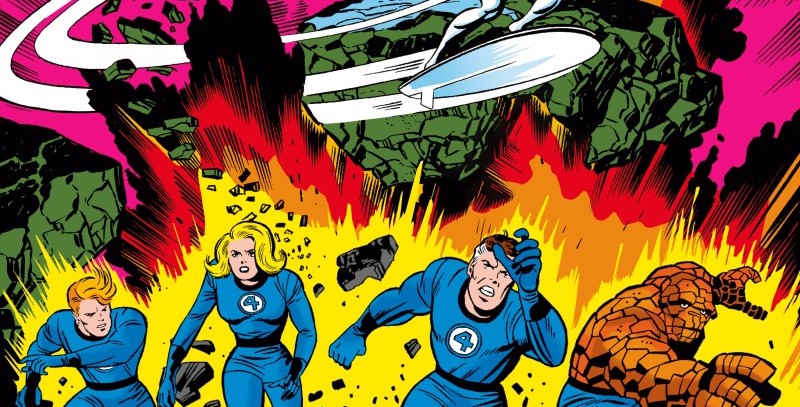
From the moment Reed Richards persuaded Sue Storm, Johnny Storm, and Ben Grimm to board an experimental rocket, Marvel’s First Family embarked on a journey that would take them far beyond Earth’s atmosphere. Along the way, they encountered not only strange worlds and alien civilizations, but also beings whose existence challenged everything humanity thought it knew about life, power, and the cosmos. Those adventures helped transform the Marvel Universe from a collection of superhero stories into a vast cosmic tapestry that continues to inspire readers more than sixty years later.
In the first article of this series, Marvel’s First Family: The Origins and Rise of the Fantastic Four, we explored how an ill-fated spaceflight created Marvel’s First Family and forever changed the lives of Reed, Sue, Johnny, and Ben. In the second installment, Facing the Threats: The Fantastic Four’s Greatest Villains, we met the enemies who tested their courage, from Doctor Doom’s relentless pursuit of power to Annihilus’ conquest of the Negative Zone.
Those stories established the Fantastic Four as explorers, scientists, and heroes. Their greatest adventures, however, would take them beyond supervillains and into encounters with beings whose influence reached across galaxies—or even embodied the universe itself.
This article isn’t a guide to Marvel’s cosmic hierarchy. Instead, it’s the story of how the Fantastic Four became the gateway through which readers first experienced Marvel’s greatest cosmic mysteries.
Born of the Cosmos
The Fantastic Four’s relationship with the cosmos began before they ever met Galactus or the Silver Surfer.
It began with curiosity.
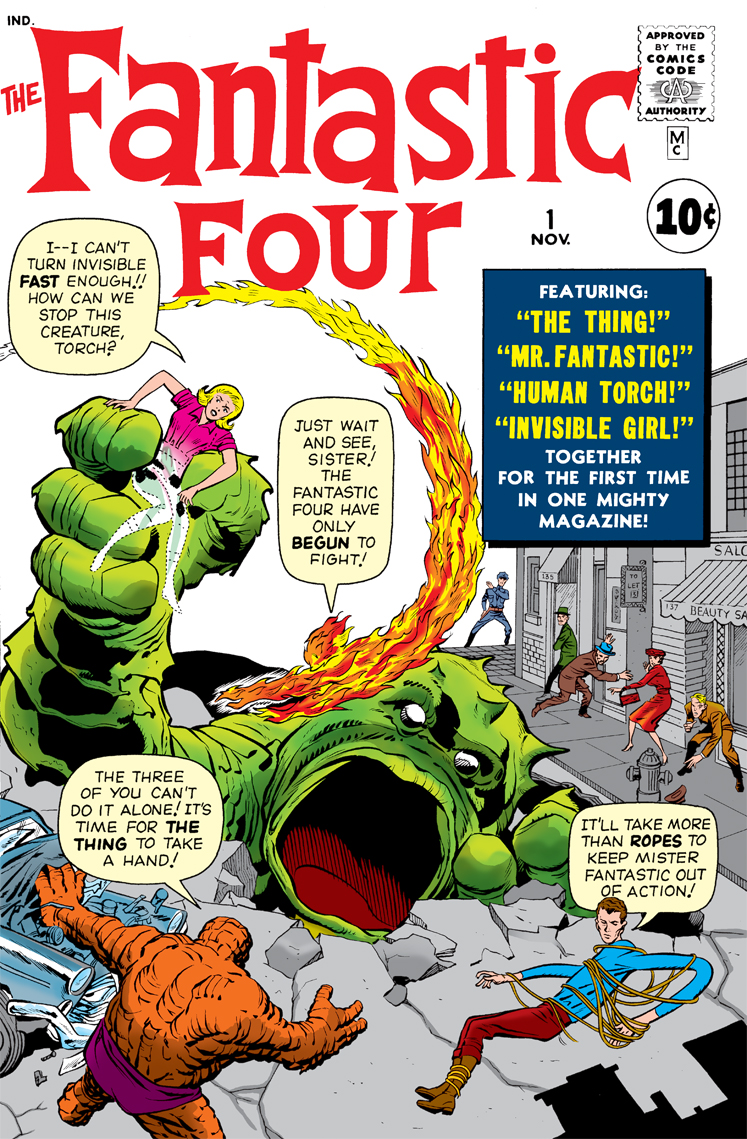
In Fantastic Four #1, “The Fantastic Four!” (November 1961), writer Stan Lee and artist Jack Kirby introduced four ordinary people willing to risk everything for the sake of exploration. Reed Richards believed humanity stood on the threshold of a new age of space travel, and he was unwilling to wait for history to catch up. Convinced that another nation might reach the stars first, he launched his experimental spacecraft before it had been adequately shielded against cosmic radiation.
The decision proved disastrous.
Bombarded by cosmic rays, the crew returned to Earth forever changed. Reed gained the ability to stretch his body beyond normal human limits. Sue developed the power of invisibility and, later, nearly indestructible force fields. Johnny discovered he could engulf himself in flame and soar through the sky, while Ben Grimm was transformed into the immensely powerful Thing.
Their powers came from the cosmos, but that did not make them cosmic beings.
They remained wonderfully, frustratingly human. Reed still wrestled with impossible scientific questions. Sue became the emotional center of the family. Johnny retained his youthful impulsiveness, and Ben continued to struggle with the loss of the life he once knew. Cosmic rays gave them extraordinary abilities, but they never separated them from the hopes, fears, and relationships that made them relatable.
That humanity would become their greatest strength.
Unlike many superheroes who confronted danger with fists alone, the Fantastic Four approached the unknown with curiosity. Reed wanted to understand it. Sue looked for the human cost behind every conflict. Johnny embraced the excitement of discovery, while Ben’s compassion often reminded everyone that even the strangest beings deserved to be judged by more than appearances.
Those qualities prepared them for encounters unlike anything Marvel readers had seen before.
Looking Beyond the Stars
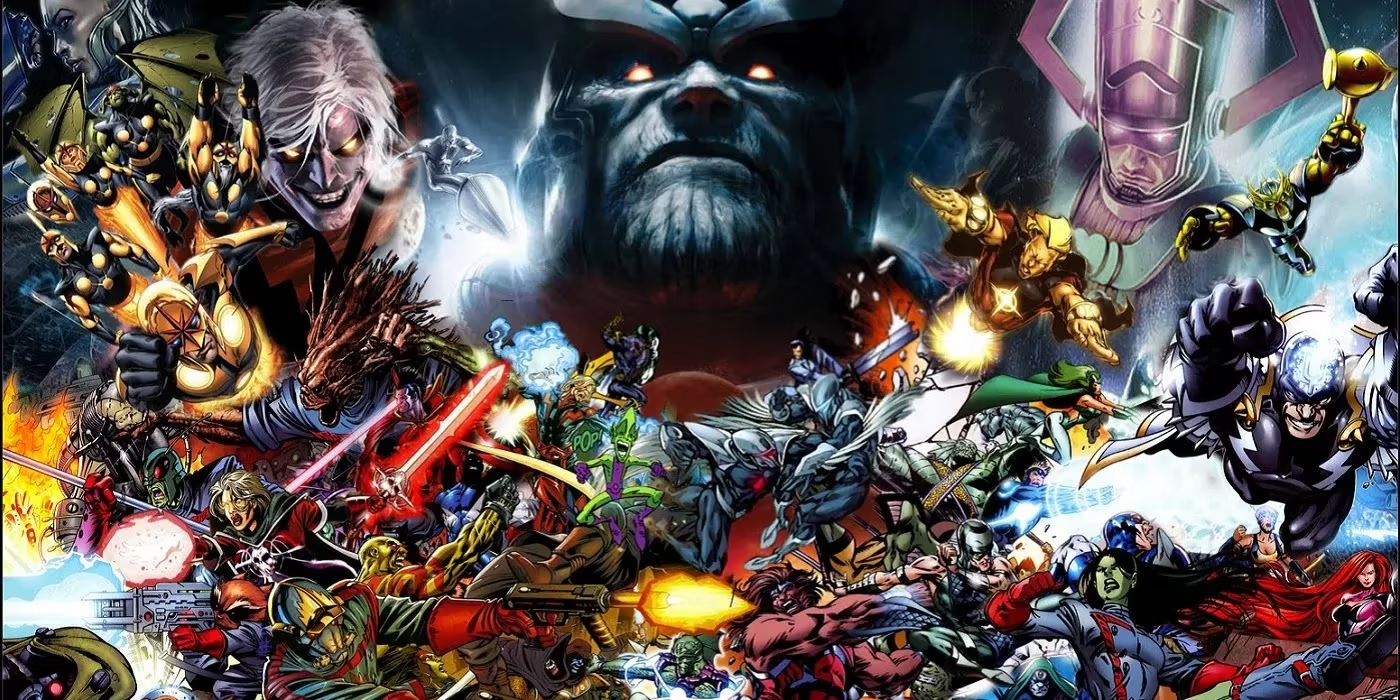
When readers think of the Marvel Universe today, they often picture an endless cosmos filled with alien empires, living planets, and godlike beings. In the early 1960s, however, those ideas were still taking shape. Stan Lee and Jack Kirby didn’t reveal the full scope of the universe all at once. They expanded it one remarkable story at a time, and the Fantastic Four stood at the center of that expansion.
Before we continue, it’s helpful to distinguish between two very different kinds of characters that inhabit Marvel’s cosmos.
The first are alien civilizations.
The Kree, Skrulls, Shi’ar, Brood, and countless other races are exactly what their names suggest—civilizations. They establish governments, build starships, wage wars, forge alliances, and pursue political ambitions much as humanity has throughout history. They may possess astonishing technology or abilities beyond anything found on Earth, but they remain societies populated by living beings.
We’ll revisit those civilizations in the next article of this series, where the focus shifts from cosmic exploration to the expanding family of the Fantastic Four.
Cosmic entities exist on an entirely different level.
Rather than ruling planets or commanding armies, these beings often influence the universe itself. Some have watched civilizations rise and fall over millions of years. Others represent fundamental aspects of existence or wield power beyond ordinary comprehension. They are not simply powerful aliens; they occupy a place in Marvel’s mythology that transcends governments, species, and even time.
The Fantastic Four did not seek out these extraordinary beings.
Instead, their relentless pursuit of knowledge repeatedly placed them at the crossroads of humanity and the unimaginable.
That journey truly began on the Moon.
The Watcher Opens the Door
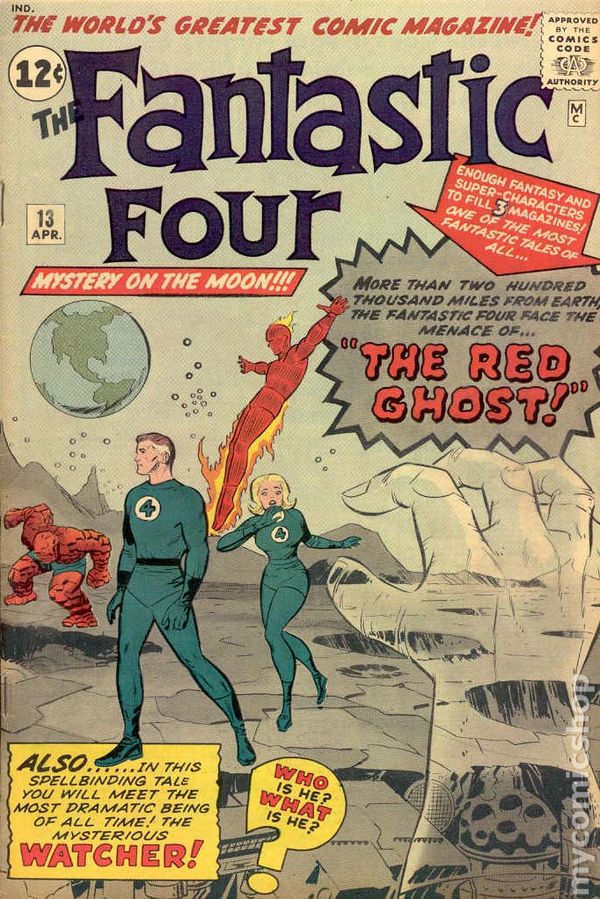
The Fantastic Four’s first encounter with a cosmic entity arrived in Fantastic Four #13, “The Red Ghost and His Indescribable Super-Apes!” (April 1963) by Stan Lee and Jack Kirby. At first glance, the issue appears to be another race into space, as Reed Richards and his team compete against the villainous Red Ghost to become the first explorers to reach the Moon.
History remembers the issue for an entirely different reason.
Hidden among the lunar landscape was a mysterious figure who would become one of the most important supporting characters in Fantastic Four history: Uatu, the Watcher.
Unlike previous characters introduced in Marvel Comics, Uatu neither sought conquest nor offered immediate assistance. He belonged to an ancient race known as the Watchers, whose members had sworn never again to interfere in the development of younger civilizations after witnessing the catastrophic consequences of sharing advanced knowledge with another world.
It was an unusual concept for a superhero comic.
Readers had grown accustomed to heroes and villains taking sides in every conflict. Uatu existed outside those familiar roles. He observed, he recorded, and he learned. Only under the most extraordinary circumstances would he risk breaking the oath that had defined his existence for countless millennia.
For Reed Richards, meeting the Watcher was more than another adventure. It was the first indication that humanity’s place in the universe was far smaller—and far more significant—than anyone had imagined. Earth was no longer an isolated world discovering space one rocket launch at a time. It had become a planet worthy of observation by beings whose lifespans stretched beyond recorded history.
That revelation quietly changed the direction of the Fantastic Four.
Until then, their adventures had largely expanded outward from Earth.
Soon, the universe itself would come looking for them.
When Galactus Changed Everything
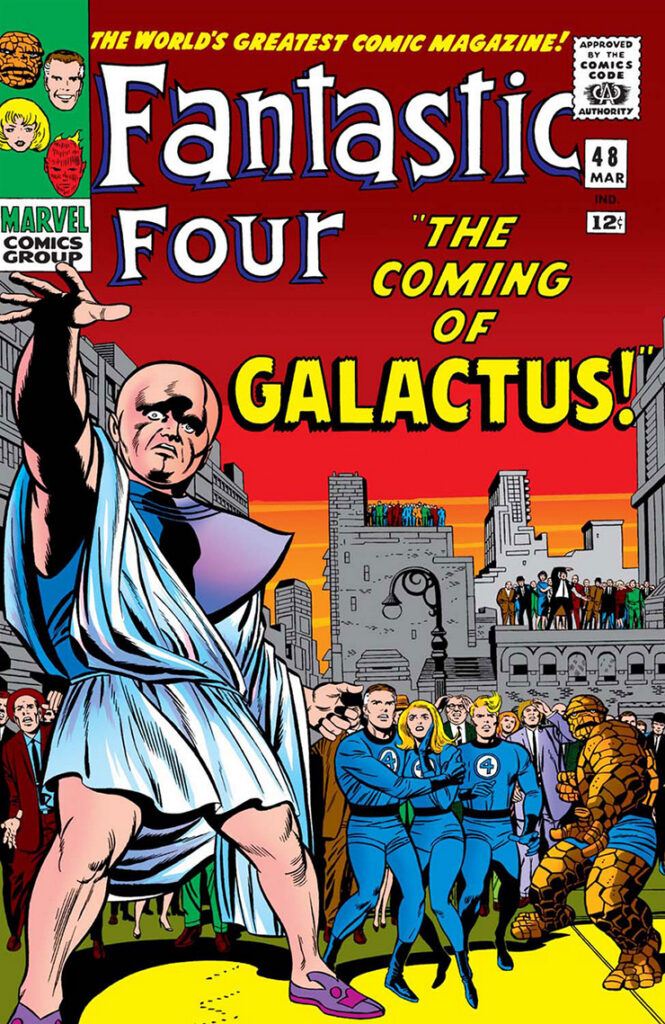
If the Watcher hinted that the Marvel Universe was larger than anyone had imagined, Galactus proved it.
That watershed moment arrived in Fantastic Four #48, “The Coming of Galactus” (March 1966), continued in Fantastic Four #49, “If This Be Doomsday!” (April 1966), and concluded in Fantastic Four #50, “The Startling Saga of the Silver Surfer!” (May 1966). Created by Stan Lee and Jack Kirby, these three issues—known collectively as The Galactus Trilogy—are widely regarded as one of the defining stories in comic book history.
The trilogy opens with an unusual sense of foreboding. The Watcher, who had spent years observing humanity while honoring his vow of non-interference, suddenly abandons his detached role. He seeks out the Fantastic Four because he recognizes that Earth faces a threat unlike any it has ever known.
That decision alone tells readers everything they need to know.
If the Watcher is willing to break his sacred oath, whatever is approaching must be beyond imagination.
Before Galactus himself arrives, another mysterious figure appears. A gleaming silver being descends from the stars to scout the planet for his master. This is the first appearance of the Silver Surfer, a character whose quiet dignity and growing conscience would make him one of Marvel’s most enduring heroes.
Unlike the conquerors the Fantastic Four had battled before, the Silver Surfer harbors no personal hatred for Earth. He simply fulfills the role assigned to him by his master, searching the universe for worlds capable of sustaining Galactus’ endless hunger. That quiet obedience makes him far more complex than the typical comic book villain. Readers quickly sense that beneath his calm exterior lies someone capable of questioning the path he has chosen.
Then Galactus arrives.
Lee and Kirby deliberately avoided introducing him as another costumed mastermind with dreams of conquest. Galactus does not threaten Earth because he seeks wealth, revenge, or political power. He comes because he must feed. Entire planets become nourishment for a being whose existence is tied to the balance of the cosmos.
That simple idea fundamentally changed the way Marvel readers thought about villains.
Galactus wasn’t evil in the traditional sense. He was terrifying because his actions were as natural—and as unavoidable—as a hurricane or an earthquake. Humanity wasn’t facing a criminal or a dictator. It was confronting a force of nature that viewed Earth the way people might view a single grain of sand.
Faced with an impossible enemy, the Fantastic Four respond in ways that perfectly reflect their individual strengths.
Rather than searching for a bigger weapon or stronger ally, Reed Richards searches for understanding and strategy. Johnny Storm undertakes a desperate mission to retrieve the Ultimate Nullifier from Galactus’ worldship, knowing the fate of Earth rests on his success. Sue Storm refuses to surrender hope even as the odds become overwhelming, while Ben Grimm stands ready to defend his family despite recognizing how hopeless the battle appears.
Each member contributes something essential.
No one saves the world alone.
One of the trilogy’s most memorable moments belongs not to a superhero, but to Alicia Masters, the Thing’s ever-loving girlfriend.
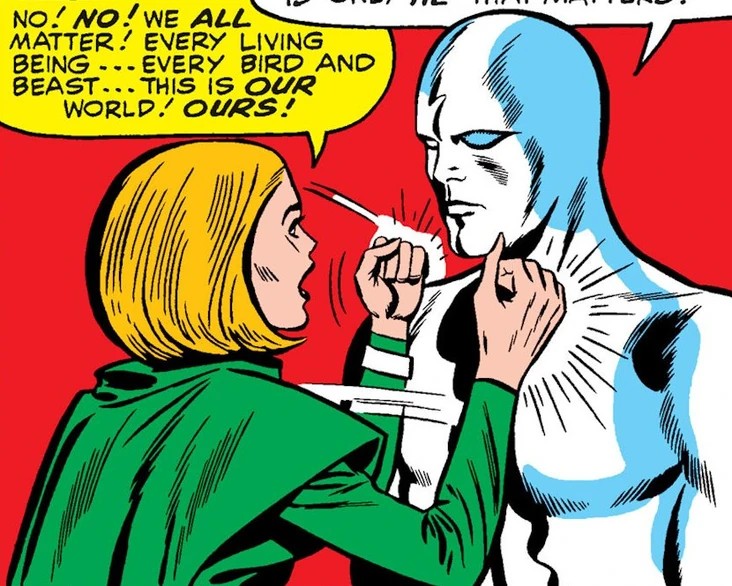
Blind since childhood, Alicia sees something in the Silver Surfer that no one else recognizes. She looks beyond his role as Galactus’ herald and speaks to the compassion buried beneath years of loyal service. Her kindness awakens the Surfer’s conscience, forcing him to confront the suffering his actions have caused across countless worlds.
Without Alicia’s influence, the outcome of the story might have been very different.
It’s a reminder that the Fantastic Four’s greatest victories rarely come through strength alone. Compassion, empathy, and understanding often prove just as powerful as Reed’s inventions or Ben’s fists.
The trilogy reaches its climax when Reed confronts Galactus with the Ultimate Nullifier. Rather than destroying the Devourer of Worlds, Reed demonstrates that humanity possesses both the means and the courage to defend itself. Galactus chooses to spare Earth, while the Silver Surfer pays a heavy price for his defiance, becoming permanently exiled to the very planet he helped save.
Marvel Comics would never be the same.
The Galactus Trilogy expanded the company’s storytelling in ways that are difficult to overstate. Until then, space had largely been a backdrop for adventures involving strange planets and alien invaders. Lee and Kirby revealed something far grander. Beyond those distant worlds existed beings whose lives unfolded on a scale almost impossible to comprehend.
The Fantastic Four stood at the center of that revelation.
Readers didn’t simply meet Galactus and the Silver Surfer. Through Reed, Sue, Johnny, and Ben, they discovered that the Marvel Universe contained mysteries far greater than anyone had suspected. The Fantastic Four weren’t merely exploring outer space anymore.
They were exploring the very nature of the cosmos.
If you’d like to take a deeper look at these legendary characters, be sure to visit my companion articles exploring the history and evolution of Galactus, the origins of the Silver Surfer, and the question that has fascinated readers for decades: is the Silver Surfer truly a hero, a villain, or something in between?
The Galactus Trilogy established the Fantastic Four as Marvel’s premier cosmic explorers, but it also raised a question that would return years later in even more dramatic fashion.
What happens when saving the universe means saving Galactus himself?
When Understanding Mattered More Than Victory
Over the years, Reed Richards came to understand something few others in the Marvel Universe could accept. Galactus was not merely a cosmic predator. As terrible as his hunger appeared, he served a purpose within the natural order of the universe. Destroying him outright might satisfy a desire for justice, but it could also upset a balance that no one fully understood.
That belief would place Reed at the center of one of the most thought-provoking stories in Fantastic Four history.
The saga begins in Fantastic Four #242, “Terrax Untamed” (May 1982), continues through Fantastic Four #243, “Shall Earth Endure?” (June 1982), and concludes in Fantastic Four #244, “Beginnings and Endings” (July 1982) by writer and artist John Byrne.
After being gravely weakened, Galactus crash-lands on Earth. His longtime herald, Terrax, abandons him, leaving the once-unstoppable world devourer close to death. Earth’s heroes gather with a simple goal: prevent Galactus from recovering and eliminate him while they finally have the opportunity.
Reed Richards sees the situation differently.
To him, Galactus is no longer an invading enemy but a dying living being. More importantly, Reed believes the universe itself may depend upon Galactus’ continued existence. Choosing compassion over vengeance, he helps restore Galactus to full strength, allowing him to leave Earth in search of another source of sustenance.
The decision outrages many of Earth’s heroes.
It also carries consequences far beyond our planet.
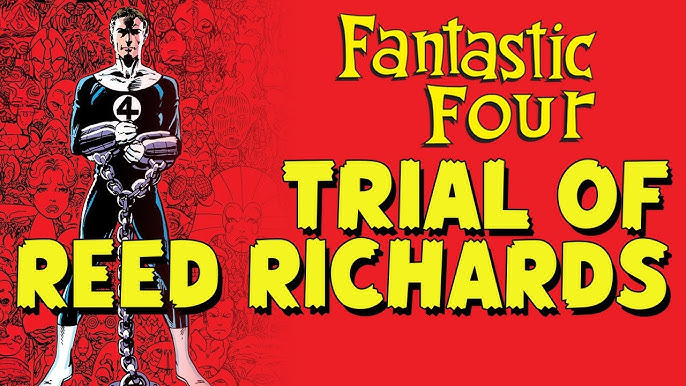
Those consequences come to a head in Fantastic Four #261, “The Trial of Reed Richards” (December 1983) and Fantastic Four #262, “The Trial of Reed Richards—Conclusion” (January 1984), again written and illustrated by John Byrne.
Transported across the cosmos, Reed stands trial before an alien tribunal representing civilizations that have suffered at Galactus’ hands. Their accusation is straightforward: by saving Galactus, Reed Richards has condemned countless future worlds to destruction.
It is an argument that is difficult to dismiss.
Every witness has experienced unimaginable loss. Entire civilizations have disappeared because Galactus needed to survive. From their perspective, Reed’s mercy seems almost unforgivable.
Yet Reed refuses to defend his actions by appealing to emotion. Instead, he argues that Galactus is not simply another sentient being making moral choices. Like gravity, time, or the cycle of life and death, Galactus performs a necessary function within the cosmic order. Eliminating him might create consequences far more catastrophic than anyone present can foresee.
The trial never offers readers an easy answer.
Instead, it invites them to wrestle with one of Marvel’s greatest ethical questions.
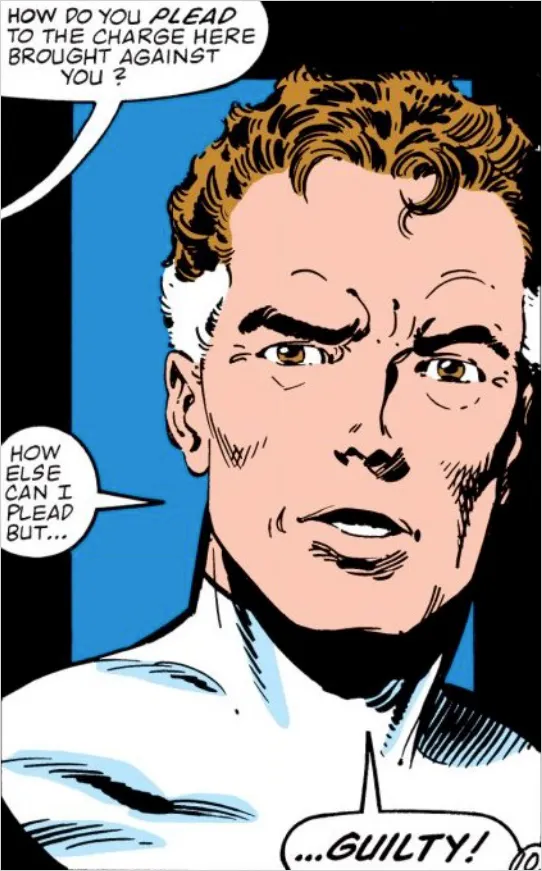
Is it right to preserve one life if doing so may cost millions of others?
For Reed Richards, the answer was never about choosing Galactus over innocent worlds. It was about recognizing that the universe often operates according to laws that human beings may never fully understand.
That willingness to seek understanding before judgment has always separated the Fantastic Four from many of their fellow heroes.
While others often ask, “How do we defeat this enemy?” Reed asks a different question.
“What are we truly dealing with?”
That curiosity has repeatedly led the Fantastic Four into encounters with beings whose motives cannot be measured by ordinary standards of good and evil.
Galactus was only the first.
As the years passed, the Fantastic Four continued to cross paths with some of the most extraordinary figures in Marvel’s cosmic mythology. Their adventures brought them before the ancient Celestials, whose experiments shaped the evolution of intelligent life across the galaxy. They witnessed the immense power of the Beyonder during the original Secret Wars, a being whose near-limitless abilities challenged heroes and villains alike to examine their deepest desires.
On other occasions, Reed and his family found themselves standing before cosmic abstracts such as Eternity and the Living Tribunal—beings whose responsibilities extended far beyond individual planets or civilizations. These encounters were seldom about defeating an opponent. Instead, they reminded readers that the Fantastic Four occupied a unique place within the Marvel Universe. They were explorers invited to witness wonders that most heroes would never experience.
Taken individually, each of these stories expanded Marvel’s mythology.
Together, they accomplished something even greater.
They transformed the Fantastic Four from a team of superheroes into the guides through whom readers could explore the vastness of the Marvel Universe itself.
The Legacy of Marvel’s Greatest Explorers
More than sixty years after their debut, the Fantastic Four remain Marvel’s greatest explorers. They weren’t simply the first family of superheroes—they were the team that continually pushed beyond the next frontier. Through their adventures, readers discovered that the Marvel Universe was far more than masked heroes battling colorful villains. It was a living cosmos filled with impossible wonders, difficult moral questions, and beings whose existence challenged humanity’s understanding of reality itself.
Whether standing before the Watcher for the first time, facing the unimaginable power of Galactus, or witnessing the vast hierarchy of cosmic entities that followed, Reed Richards, Sue Storm, Johnny Storm, and Ben Grimm repeatedly demonstrated that curiosity, compassion, and courage could accomplish what brute strength alone never could. They didn’t just survive encounters with the unknown—they helped us understand it.
Perhaps that’s the Fantastic Four’s greatest superpower. More than any other heroes in Marvel Comics, they inspired generations of readers to look beyond the stars and imagine what might be waiting there.
Continue Your Fantastic Four Journey
If you enjoyed this article, you may also like these related features here on SuperHeroCollectors.com:
- Marvel’s First Family: The Origins and Rise of the Fantastic Four
- Facing the Threats: The Fantastic Four’s Greatest Villains
- The Evolution of Galactus in Marvel Comics and Films
- Who Is the Silver Surfer?
- Is the Silver Surfer a Hero or a Villain?
Coming next in this series:
Family Matters: The Kree, Skrull, and New Additions to the Fantastic Four
We’ll leave behind cosmic entities and explore something even more personal: how Marvel’s First Family grew through children, adoption, and the relationships that made the Fantastic Four much more than a superhero team.
Join the Conversation
Now I’d like to hear from you.
Which Fantastic Four cosmic encounter has stayed with you the most over the years? Was it your first glimpse of the Watcher on the Moon, the unforgettable arrival of Galactus, the Silver Surfer’s decision to stand against his master, or Reed Richards’ controversial choice to save Galactus?
Perhaps there’s another cosmic adventure you think deserves to be included whenever fans discuss the Fantastic Four’s greatest stories.
Share your thoughts in the comments below. I’d love to hear which stories shaped your appreciation for Marvel’s First Family—and if there’s a favorite cosmic tale I didn’t mention, let me know. Your recommendation might inspire a future article here on SuperHeroCollectors.com.
As someone who grew up watching Marvel’s family adventures and diving into the comic versions too, the Fantastic Four has always held a special place for me. They weren’t just superheroes; they felt like explorers who carried the heart of a family into the unknown. What fascinates me most is how their humanity never got lost in the cosmic scale of their stories. Reed’s curiosity, Sue’s compassion, Johnny’s youthful energy, and Ben’s struggle with identity made them unforgettable.
The Galactus Trilogy especially stands out. It wasn’t just about fighting a villain, but about grappling with questions bigger than good versus evil. That blend of cosmic wonder and deeply human choices is what makes the Fantastic Four so unique and timeless. For me, they’ll always be Marvel’s most fascinating family, the ones who taught us that courage and compassion can reach as far as the stars.
HI Alysanna,
Thank you for reading and taking the time to comment. I’m glad you enjoyed the post. Stay tuned for some more Fantastic Four fun as we look into how the family expanded.
– Scott
Scott, the part that still hits hardest for me is Reed saving Galactus because it turns a superhero story into a real ethical problem rather than a clean win-or-lose moment. That choice gets at why the Fantastic Four work so well in the cosmic corner of Marvel; they are not just punching threats; they are trying to understand what kind of universe they actually live in.
I’m also curious whether you see the Watcher as the more important long-term addition to FF mythology, since he kinda frames many of these encounters before the bigger names arrive. And when you get to the Kree and Skrulls in the next piece, it would be fun to see how you connect those sprawling empires back to the family dynamic that keeps the team grounded.
Thanks, Aly! I think you put your finger on what separates the Fantastic Four from many other superhero teams. Reed’s decision to save Galactus is one of those moments where there isn’t an easy “right” answer. He’s looking beyond Earth and considering the balance of the entire universe. It’s the kind of moral dilemma that has made that storyline memorable for decades.
I also agree about the Watcher. Uatu often gets overshadowed by characters like Galactus and the Silver Surfer, but he really is the gateway to Marvel’s cosmic stories. His presence reminds us that these events have consequences far beyond Earth, and his relationship with the Fantastic Four becomes more significant the longer you follow their history.
You’re also thinking along the same lines I am for the next article. The Kree and Skrulls aren’t just another pair of alien races to fight—they become part of the Richards family’s story. One of the things I’ve always appreciated about the Fantastic Four is that no matter how large the conflict becomes, whether it’s a universal threat or an interstellar war, it always comes back to family. That’s a theme I definitely plan to explore.
Thanks again for a great comment!
Scott
well written and fun to read. Thought I knew the Fantastic Four pretty well, but it is fascinating to hear about their beginnings. I never thought about the perspective that they are “frustratingly human” and how that is one of thier most interesting and appealing aspects. They have fought some of the most interesting villains as well, very fun to think about all their adventures in space, especially considering they were written in the heart of the space race.
Thanks, John! I’m glad you enjoyed it. I think that’s one of the reasons the Fantastic Four have endured for so long. They may battle world-devourers and cosmic empires, but they’re still a family that argues, makes mistakes, and occasionally gets on each other’s nerves. That “frustratingly human” quality keeps them relatable even when the stories become incredibly cosmic.
You also make a great point about the timing. The Fantastic Four debuted right in the middle of the Space Race, when people were captivated by the idea of exploring the unknown. Stan Lee and Jack Kirby tapped into that excitement and imagined what might be waiting beyond Earth. Looking back now, it’s amazing how many of those adventures introduced characters and concepts that still shape Marvel stories more than sixty years later.
Thanks for taking the time to read and leave such a thoughtful comment!
Be sure to come back for more superhero fun!
– Scott
I enjoyed how you explained the larger cosmic story rather than simply listing characters or events. As someone who isn’t deeply involved in comic collecting, I found your writing easy to follow and it helped me understand why Galactus is such an iconic figure in the Marvel universe. It’s always nice when an article can make a complex topic accessible to newcomers. Thanks for putting this together!
Thanks so much, Bryce! That means a lot because making these topics approachable is one of my main goals. Marvel’s cosmic stories can become overwhelming pretty quickly, with decades of continuity and dozens of interconnected characters. I want readers who have never picked up a comic to be able to enjoy the journey just as much as longtime fans.
Galactus is a perfect example. On the surface, he’s the “Devourer of Worlds,” but the more you learn about him, the more you realize he’s far more than a typical villain. That complexity is one of the reasons he’s remained one of Marvel’s most compelling characters for over sixty years.
I’m really glad you found the article helpful, and I appreciate you taking the time to leave such encouraging feedback. I hope you’ll enjoy the next article in the Fantastic Four series as well!
Stay tuned for more superhero fun!
– Scott
I really liked how you broke down Reed’s decision to save Galactus instead of just letting him perish, because it completely shifts the story from a typical superhero win into a messy ethical dilemma. I’ve always struggled with that part of the comics since it feels like Reed is prioritizing cosmic balance over the actual lives that Galactus would go on to consume.
When you look at the trial storyline, do you think Reed’s argument about Galactus being a necessary force of nature actually holds up, or was it mostly just his scientific curiosity blinding him to the moral cost?
Thanks, Ropata! That’s one of the reasons that storyline has remained so memorable—it doesn’t offer an easy answer. If Reed had simply defeated Galactus, the story would have ended like so many other superhero battles. Instead, it leaves readers debating whether he made the right choice more than forty years later.
I tend to think Reed genuinely believed Galactus was a necessary part of the universe rather than acting out of scientific curiosity. Reed is certainly fascinated by the unknown, but he also understands that removing something as fundamental as Galactus could have consequences no one fully grasps. The trial itself reinforces that idea by introducing cosmic beings who argue that Galactus serves a purpose beyond human understanding.
That said, your concern is exactly what makes the dilemma so compelling. Reed is asking humanity to accept the deaths of worlds they’ve never seen for the sake of preserving the universe’s balance. That’s a difficult argument to embrace, especially when you’re looking at it from the perspective of Galactus’s victims. I don’t think Marvel intended readers to walk away with a simple answer, and that’s what elevates the story beyond a typical superhero adventure.
Thanks for such a thoughtful question. Discussions like this are one of the things I enjoy most about writing these articles.
I hope you’ll come back for more superhero fun!
– Scott
The part I kept thinking about was Alicia Masters being the person who finally reached the Silver Surfer. Everyone else was understandably focused on Galactus and the danger to Earth, but Alicia responded to the individual standing in front of her rather than treating him as just another enemy. I find it interesting that such a huge cosmic story turns on one quiet conversation and an act of compassion, not simply on Reed’s technology or the team’s powers. It also made the Silver Surfer’s punishment feel much more personal afterward. Did Alicia and the Silver Surfer continue to have a meaningful connection in later comics, or was their meeting mainly used as the turning point for this particular story?
Thanks, Hanna! I’m glad you brought up Alicia because she often gets overlooked when people talk about the Galactus trilogy. As you pointed out, she doesn’t defeat anyone with superpowers or brilliant inventions. She simply sees Norrin Radd as a person instead of an enemy, and that compassion is what changes the course of the entire story. It’s one of my favorite moments in the saga because it reminds us that heroism isn’t always about strength.
Their friendship definitely continues beyond Fantastic Four #48–50. In fact, you can see its impact almost immediately in Fantastic Four #51, where Ben Grimm becomes jealous of the bond Alicia has formed with the Silver Surfer. It’s a very human subplot that reminds us these cosmic adventures still affect the relationships within the Fantastic Four family. Years later, in Silver Surfer (Vol. 3) #123, the Surfer returns to Earth and seeks Alicia out because she’s one of the few people he feels truly understands him. Those stories make it clear their friendship wasn’t just a plot device to stop Galactus—it remained one of the Surfer’s most meaningful connections.
You’re also right about Galactus’s punishment making the story more personal. Being exiled to Earth means the Surfer pays a tremendous price for doing the right thing, which makes his sacrifice even more powerful. Moments like these are a big part of why that trilogy is still considered one of Marvel’s greatest stories.
Thanks for such a thoughtful comment!
I hope you will come back for more superhero fun!
– Scott
Wow, I like reading this. The Fantastic Four have always been a favorite of mine, and I liked the way you described each of their personal characteristics. You’ve made me want to revisit each of their movies for sure, and I was also led to your post about the Avengers Movies Chronological Order, which is also very interesting. Thanks for this fun read. – Shirley
I do have a question: which streaming service do you recommend for watching Marvel movies?
Thank you so much, Shirley! I’m really glad you enjoyed the article, and it’s great to hear it inspired you to revisit the Fantastic Four movies. They may vary in style and quality, but it’s always fun to see how each one interprets Marvel’s First Family. I’m also happy you found the Avengers chronology article. It’s one of my favorite guides to update because the Marvel universe keeps growing!
As for streaming, if you’re mainly interested in Marvel movies, I’d recommend Disney+. It has the largest collection of MCU films and series in one place, making it the easiest way to watch them in release or chronological order. What is really cool on their menu is that they actually have a guide for watching the movies in chronological order. The older Fantastic Four films from Fox have rotated between streaming services over the years, but Disney+ often carries them as well since Disney acquired 20th Century Fox. If a particular movie isn’t available there, services like Prime Video, Apple TV, or Fandango at Home often have it available to rent or purchase.
The newest FF movie that came out last year is different from the comics. This is because it happens in the multiverse on a parallel earth. It was really quite interesting.
Thanks again for your kind words and for taking the time to leave such a thoughtful comment. I hope you’ll enjoy the next article in the Fantastic Four series too!
Please come back for more superhero fun!
– Scott
The Fantastic Four are not just superheroes; they are explorers who opened the door to Marvel’s cosmic side. The Galactus Trilogy especially shows how Lee and Kirby shifted the narrative from villains with motives to forces of nature that couldn’t be fought with fists alone. That’s a turning point: Galactus wasn’t “evil”; he was inevitable, and the team’s response reflected curiosity, compassion, and strategy rather than brute strength.
Alicia Masters’ empathy changed the Silver Surfer’s conscience is powerful. It highlights how the Fantastic Four’s victories often come from humanity and understanding, not just powers. Later arcs like The Trial of Reed Richards push that even further, forcing readers to wrestle with whether preserving Galactus was mercy or madness. That tension is exactly what elevated the Fantastic Four into Marvel’s premier cosmic explorers.
Even decades later, that legacy holds. The Fantastic Four’s greatest superpower isn’t stretching, invisibility, fire, or strength; it’s showing that curiosity and compassion can stand alongside courage when facing the unknown. That’s why their stories still resonate: they remind us that exploration is about more than discovery; it’s about perspective. It was a great read
David.
Thanks, Bishop! I really appreciate your thoughtful reflection on the article.
I especially like your observation that the Fantastic Four are explorers first and superheroes second. That’s one of the qualities that has always set them apart from other Marvel teams. So many of their greatest stories aren’t about defeating an enemy—they’re about encountering the unknown and deciding how to respond to it.
You also summed up the heart of the Galactus saga perfectly. The real victory wasn’t simply surviving Galactus; it was the compassion Alicia showed the Silver Surfer and the willingness of Reed and the team to think beyond the obvious solution. Those moments are what transformed the story from a great adventure into a timeless one.
Thanks again for reading and for taking the time to share your thoughts. Comments like yours make these discussions even more enjoyable.
Please come back again soon for more superhero content!
– Scott
Wow, this is basically updating everyone before the see the Fantastic Four movie! I have never read a full Marvel comic in my life, but the movies I think brought comic book only and movies only fans together. Don’t get me wrong, I don’t mind reading the comics, just never had much interest. I don’t care what Martin Scorsese says, it’s cinema! Thanks for catching me up.
Thanks, Derrick! I’m glad the article helped bridge the gap between the comics and the movies.
One thing I’ve always enjoyed is seeing how the films introduce people to characters they might never have discovered otherwise. The comics often provide extra background and context that make those movie moments even more meaningful, but you certainly don’t have to be a lifelong comic reader to appreciate these stories.
I’m with you on Galactus and the Silver Surfer—they’re among Marvel’s most fascinating cosmic characters, and their comic book history is well worth exploring. Hopefully this article gives you a good starting point if you ever decide to dive into some of those classic Fantastic Four issues.
Thanks for reading and for taking the time to leave a comment!
Great read! I like how you tied the Fantastic Four’s adventures into the broader Marvel Universe instead of just focusing on individual characters. The progression from their origins, to their villains, and now their cosmic journey makes the series easy to follow. Looking forward to reading the next installment!
Really enjoyed this article. I like how you’ve connected the Fantastic Four’s early adventures with the larger cosmic side of Marvel. It flows well, is easy to read, and makes me want to continue with the rest of the series. Great work!
Thanks so much, Richie! I really appreciate you following the series.
That progression was exactly what I was hoping to achieve. Rather than treating each article as a standalone topic, I wanted readers to see how the Fantastic Four evolved from a family of adventurers into the team that opened the door to Marvel’s cosmic universe. Each chapter of their history builds on the one before it.
The next article shifts the focus back to the family itself and explores why they’re known as Marvel’s First Family. Even with all the cosmic adventures and larger-than-life threats, I think it’s their relationships with one another that have kept them relevant for more than sixty years.
Thanks again for reading and for your encouragement. Comments like yours make writing this series even more rewarding!
Please come back for more superhero fun!
– Scott
Scott,
One thing I find interesting about the Fantastic Four is how much they reflect the optimism of the 1960s Space Race. Reed wasn’t trying to build a weapon or win a battle—he simply wanted to explore what was beyond the next horizon. That sense of discovery is something I think later Marvel teams gradually moved away from as stories became more grounded in global threats and superhero conflicts.
Reading your series has actually made me appreciate why the Fantastic Four are often called Marvel’s First Family. They’re not just another superhero team; they’re explorers whose greatest victories often come from curiosity and understanding rather than simply overpowering an opponent. Reed’s decision regarding Galactus is probably the best example of that.
I’m curious to see where you go with the Kree and Skrulls next, because those stories really start to show how the Fantastic Four influence the wider Marvel Universe rather than just their own adventures.
Looking forward to the next installment.
Jeremy
Thanks, Jeremy! I really appreciate your thoughtful comments throughout this series.
I think you’re absolutely right about the influence of the Space Race. Stan Lee and Jack Kirby created the Fantastic Four during a time when people were fascinated by the idea of exploring the unknown, and that spirit of discovery became part of the team’s identity. Even when they’re facing incredible dangers, Reed’s first instinct is often to understand what he’s dealing with before deciding how to respond.
I’m glad you mentioned the Kree and Skrulls because they really do mark another turning point for the Fantastic Four. Those stories expand the Marvel Universe in a huge way, but they also continue to reinforce what makes the FF unique. No matter how large the conflict becomes, it still comes back to the family at the center of it all.
Thanks again for reading each article and sharing such thoughtful observations. Conversations like this are one of my favorite parts of writing the series, and I hope you’ll enjoy the next installment just as much!
Please keep coming back for more superhero fun!
– Scott
I used to think I was too old to still be into comics, but it’s great to realise I’m definitely not the only one! It’s brilliant to meet other people who still enjoy comics, superheroes, and all the fun that comes with them, regardless of age. Age really is just a number when it comes to enjoying the things that make you happy!
Thanks, Ugo! I couldn’t agree more.
One of the things I’ve come to appreciate is that comic books have grown up along with many of their readers. The stories still have the excitement and adventure that drew us in as kids, but they also explore themes like family, sacrifice, responsibility, and morality in ways that resonate with adults.
I read Marvel comics as a kid, stepped away from them for many years, and then rediscovered them later in life while building this website. Going back and reading these classic Fantastic Four stories has been a wonderful experience because I notice so many things now that I completely missed as a child.
You’re absolutely right—there’s no age limit on enjoying a good story. Whether it’s comics, novels, movies, or anything else, if it sparks your imagination and brings you joy, it’s time well spent.
Thanks for sharing your thoughts and for being part of the conversation!
Please come back for more superhero fun!
– Scott
This was a fantastic read! I really liked how you focused on the Fantastic Four as explorers rather than just superheroes. Your explanation of how the Galactus Trilogy expanded Marvel’s cosmic universe was especially interesting, and I enjoyed the way you tied the Watcher, Silver Surfer, and Galactus together into one larger story. I also thought your discussion of Reed Richards’ decision to save Galactus added a thoughtful perspective that many fans overlook. Do you think modern Marvel comics have captured that same sense of cosmic wonder, or do you feel those classic Lee and Kirby stories are still the gold standard?
Thanks so much, Lisa! I’m really glad you enjoyed the article.
I think that’s a great question. For me, the Lee and Kirby stories are still the gold standard—not because they’re necessarily more polished than modern comics, but because they introduced so many ideas that had never been seen before. Characters like Galactus, the Silver Surfer, the Watcher, the Kree, and the Skrulls all sprang from that incredible period of creativity, and they continue to shape Marvel stories today.
That said, I do think modern writers have captured that same sense of cosmic wonder at times. Jonathan Hickman’s Fantastic Four and Dan Slott’s later run both expanded the team’s role in fascinating ways while staying true to their spirit of exploration and discovery. They proved that there are still new frontiers for Marvel’s First Family to explore.
Thanks again for reading and for asking such a thoughtful question. I always enjoy discussing the classic stories alongside the newer ones!
I hope you come back for more superhero fun!
– Scott
I’ve been a Marvel fan for years, and the Fantastic Four have always been one of my favorite teams because of how different their adventures are from other superheroes. Their stories involving Galactus and the cosmic side of Marvel have always been some of the most exciting to me. Which Fantastic Four comic would you recommend for someone who wants to dive deeper into their cosmic adventures?
Thanks, Monica! I’m glad you enjoyed the article.
If someone wanted to dive into the Fantastic Four’s cosmic adventures, I’d start with the original Galactus Trilogy in Fantastic Four #48–50. It’s one of the most influential stories Marvel has ever published, introducing Galactus and the Silver Surfer while showing why the Fantastic Four are explorers as much as they are superheroes.
From there, I’d recommend Fantastic Four #242–244, where Galactus is dying and Reed Richards faces one of the most difficult moral decisions of his life. Then I’d follow that with Fantastic Four #261–262, The Trial of Reed Richards, which explores the consequences of that decision and asks some fascinating questions about justice and the balance of the universe.
Those stories are a great introduction to Marvel’s cosmic side, and they also show why the Fantastic Four have always been at the center of it.
Thanks again for reading and for your thoughtful question! I hope you enjoy exploring those classic adventures if you haven’t already.
Please come back for more superhero fun!
– Scott
I didn’t expect to get pulled into such a deep dive, but this piece really made me slow down and appreciate how layered the Fantastic Four’s cosmic stories actually are. The way you walked through their encounters — not just the big moments with Galactus or the Surfer, but the quieter shifts in perspective that came with meeting beings like the Watcher — made me think about how unusual it is for superhero stories to lean so heavily into curiosity and moral complexity.
What stuck with me most was the tension around Reed’s choices. The idea that sometimes “saving” someone like Galactus can look completely wrong from the outside, yet still be part of a bigger balance we don’t fully understand, is such a fascinating angle. It reminded me how these stories aren’t just about power or danger, but about how characters respond when the universe stops fitting into simple categories.
This article captured that feeling really well — that sense of standing at the edge of something enormous and trying to make sense of it anyway. It made me appreciate the Fantastic Four in a way I haven’t in a long time.
Thanks so much, Kiersti! Your comment really captures what I was hoping readers would take away from the article.
One of the reasons I’ve always loved the Fantastic Four is that their greatest adventures aren’t simply about defeating the next villain. They’re about encountering ideas and beings that challenge the way the team—and the reader—sees the universe. Characters like the Watcher, Galactus, and the Silver Surfer force the Fantastic Four to wrestle with questions that don’t have easy answers, and I think that’s what makes those stories so memorable.
I’m especially glad you mentioned Reed’s decision regarding Galactus. Whether readers agree with him or not, the fact that we’re still discussing that choice decades later says a lot about the depth of the story. It transformed what could have been a straightforward superhero battle into a lasting moral debate.
Thank you for taking the time to leave such a thoughtful comment. It’s always encouraging to hear that an article helped someone see these classic stories from a new perspective. I really appreciate you following along with the series!
I hope you come back for more superhero fun!
– Scott
The Trial of Reed Richards was a tough one, I remember. Looking back on it now, I’m kinda shocked they took on that weighty of an issue. It was almost like the proverbial, “If you could have killed Hitler as a child . . . ” storyline. But the way they handled it was a huge step in the maturity of the entire Marvel Universe. They just stopped moving from weekly “good guy v bad guy” storylines into much more complex stories (I think of the revelation re Prof. Xavier and Magneto’s previous relationship and how they differed in their approach to the “problem” of mutation.) Good synopsis! Very helpful.
Thanks, Don! That’s a great comparison.
The Trial of Reed Richards really does force readers to wrestle with an impossible question. It’s easy to say Galactus should have been stopped because of the countless worlds he’s consumed, but Marvel asks us to consider the consequences of removing a being that may actually be essential to the universe’s existence. There isn’t a comfortable answer, and I think that’s exactly why the story has remained so memorable.
I also agree with your observation about Marvel’s evolution. As the years went on, the stories became much more willing to explore moral gray areas instead of presenting every conflict as heroes versus villains. The Fantastic Four were often at the forefront of that shift, especially in their cosmic adventures, where the questions were sometimes more important than the battles themselves.
I’m glad you enjoyed the article, and I appreciate you sharing your thoughts. Comments like yours remind me why these classic stories are still worth revisiting decades later.
You’ve found the place for superhero fun! Come back again and check out my other posts.
– Scott