
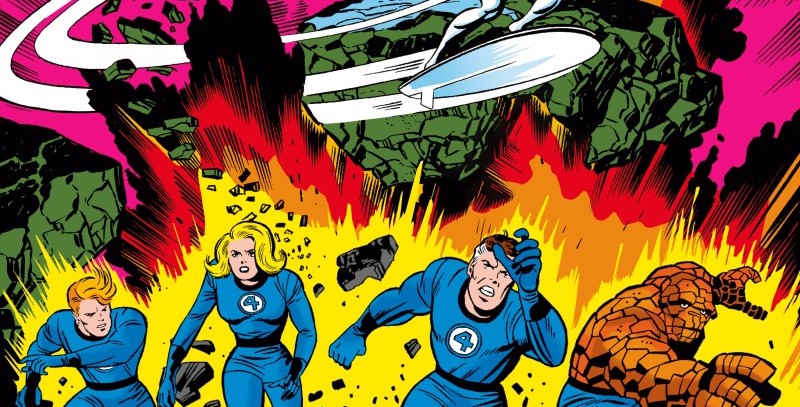
From the moment Reed Richards persuaded Sue Storm, Johnny Storm, and Ben Grimm to board an experimental rocket, Marvel’s First Family embarked on a journey that would take them far beyond Earth’s atmosphere. Along the way, they encountered not only strange worlds and alien civilizations, but also beings whose existence challenged everything humanity thought it knew about life, power, and the cosmos. Those adventures helped transform the Marvel Universe from a collection of superhero stories into a vast cosmic tapestry that continues to inspire readers more than sixty years later.
In the first article of this series, Marvel’s First Family: The Origins and Rise of the Fantastic Four, we explored how an ill-fated spaceflight created Marvel’s First Family and forever changed the lives of Reed, Sue, Johnny, and Ben. In the second installment, Facing the Threats: The Fantastic Four’s Greatest Villains, we met the enemies who tested their courage, from Doctor Doom’s relentless pursuit of power to Annihilus’ conquest of the Negative Zone.
Those stories established the Fantastic Four as explorers, scientists, and heroes. Their greatest adventures, however, would take them beyond supervillains and into encounters with beings whose influence reached across galaxies—or even embodied the universe itself.
This article isn’t a guide to Marvel’s cosmic hierarchy. Instead, it’s the story of how the Fantastic Four became the gateway through which readers first experienced Marvel’s greatest cosmic mysteries.
Born of the Cosmos
The Fantastic Four’s relationship with the cosmos began before they ever met Galactus or the Silver Surfer.
It began with curiosity.
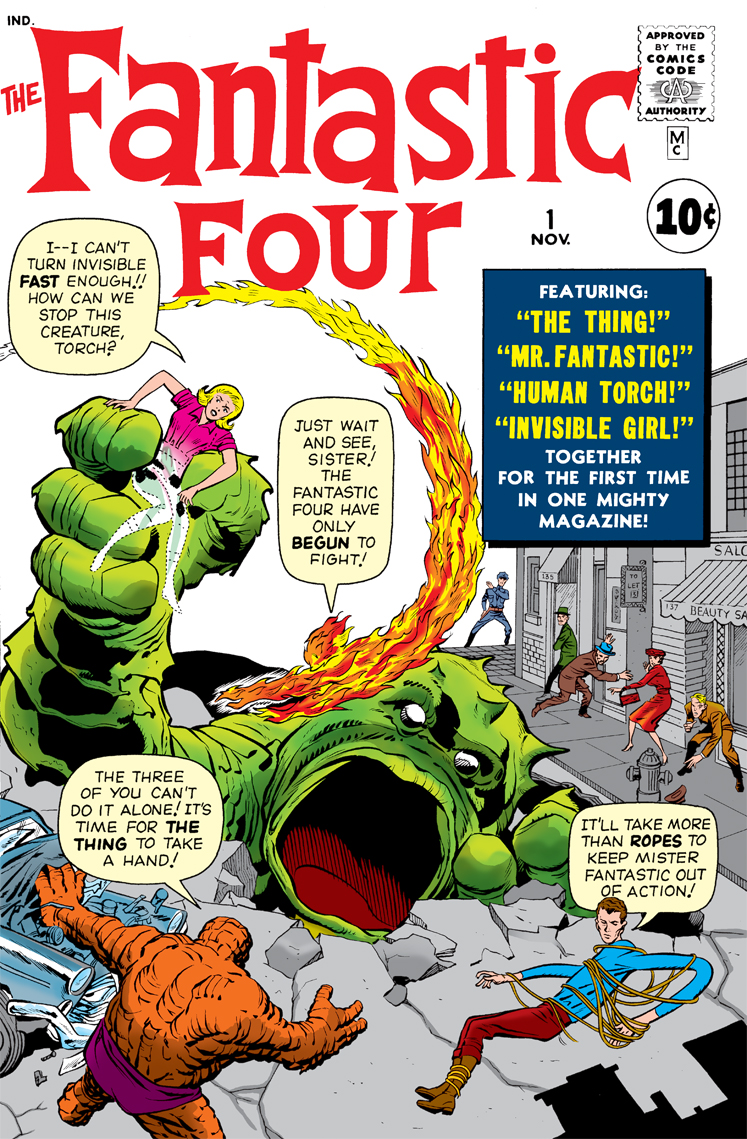
In Fantastic Four #1, “The Fantastic Four!” (November 1961), writer Stan Lee and artist Jack Kirby introduced four ordinary people willing to risk everything for the sake of exploration. Reed Richards believed humanity stood on the threshold of a new age of space travel, and he was unwilling to wait for history to catch up. Convinced that another nation might reach the stars first, he launched his experimental spacecraft before it had been adequately shielded against cosmic radiation.
The decision proved disastrous.
Bombarded by cosmic rays, the crew returned to Earth forever changed. Reed gained the ability to stretch his body beyond normal human limits. Sue developed the power of invisibility and, later, nearly indestructible force fields. Johnny discovered he could engulf himself in flame and soar through the sky, while Ben Grimm was transformed into the immensely powerful Thing.
Their powers came from the cosmos, but that did not make them cosmic beings.
They remained wonderfully, frustratingly human. Reed still wrestled with impossible scientific questions. Sue became the emotional center of the family. Johnny retained his youthful impulsiveness, and Ben continued to struggle with the loss of the life he once knew. Cosmic rays gave them extraordinary abilities, but they never separated them from the hopes, fears, and relationships that made them relatable.
That humanity would become their greatest strength.
Unlike many superheroes who confronted danger with fists alone, the Fantastic Four approached the unknown with curiosity. Reed wanted to understand it. Sue looked for the human cost behind every conflict. Johnny embraced the excitement of discovery, while Ben’s compassion often reminded everyone that even the strangest beings deserved to be judged by more than appearances.
Those qualities prepared them for encounters unlike anything Marvel readers had seen before.
Looking Beyond the Stars
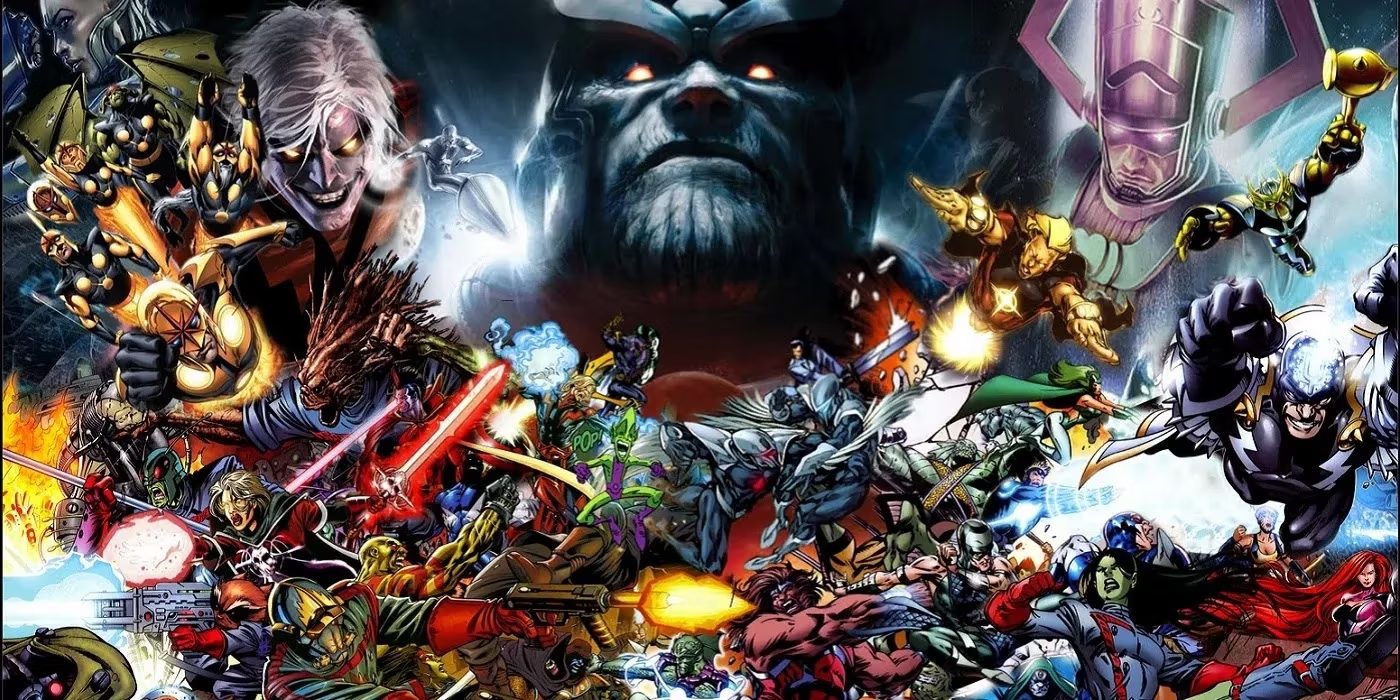
When readers think of the Marvel Universe today, they often picture an endless cosmos filled with alien empires, living planets, and godlike beings. In the early 1960s, however, those ideas were still taking shape. Stan Lee and Jack Kirby didn’t reveal the full scope of the universe all at once. They expanded it one remarkable story at a time, and the Fantastic Four stood at the center of that expansion.
Before we continue, it’s helpful to distinguish between two very different kinds of characters that inhabit Marvel’s cosmos.
The first are alien civilizations.
The Kree, Skrulls, Shi’ar, Brood, and countless other races are exactly what their names suggest—civilizations. They establish governments, build starships, wage wars, forge alliances, and pursue political ambitions much as humanity has throughout history. They may possess astonishing technology or abilities beyond anything found on Earth, but they remain societies populated by living beings.
We’ll revisit those civilizations in the next article of this series, where the focus shifts from cosmic exploration to the expanding family of the Fantastic Four.
Cosmic entities exist on an entirely different level.
Rather than ruling planets or commanding armies, these beings often influence the universe itself. Some have watched civilizations rise and fall over millions of years. Others represent fundamental aspects of existence or wield power beyond ordinary comprehension. They are not simply powerful aliens; they occupy a place in Marvel’s mythology that transcends governments, species, and even time.
The Fantastic Four did not seek out these extraordinary beings.
Instead, their relentless pursuit of knowledge repeatedly placed them at the crossroads of humanity and the unimaginable.
That journey truly began on the Moon.
The Watcher Opens the Door
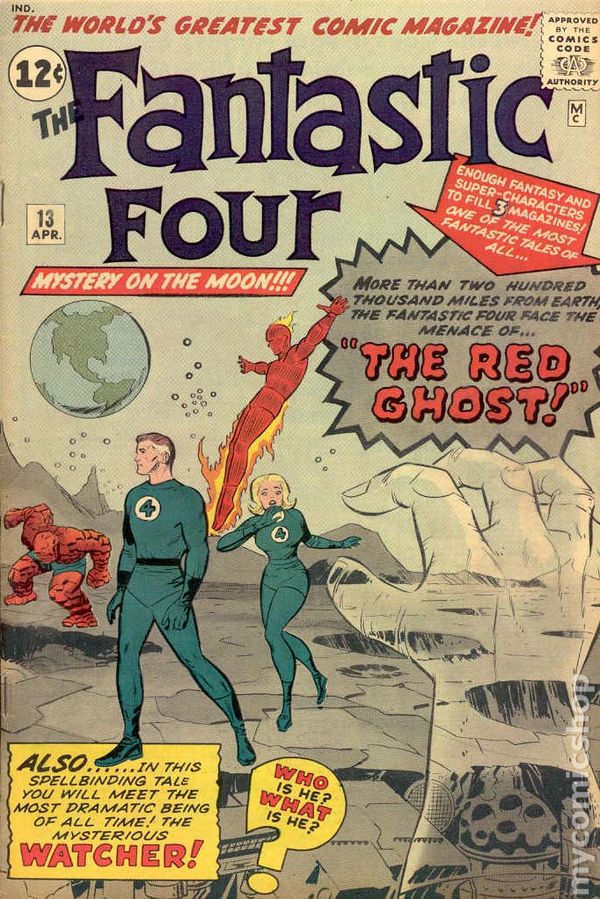
The Fantastic Four’s first encounter with a cosmic entity arrived in Fantastic Four #13, “The Red Ghost and His Indescribable Super-Apes!” (April 1963) by Stan Lee and Jack Kirby. At first glance, the issue appears to be another race into space, as Reed Richards and his team compete against the villainous Red Ghost to become the first explorers to reach the Moon.
History remembers the issue for an entirely different reason.
Hidden among the lunar landscape was a mysterious figure who would become one of the most important supporting characters in Fantastic Four history: Uatu, the Watcher.
Unlike previous characters introduced in Marvel Comics, Uatu neither sought conquest nor offered immediate assistance. He belonged to an ancient race known as the Watchers, whose members had sworn never again to interfere in the development of younger civilizations after witnessing the catastrophic consequences of sharing advanced knowledge with another world.
It was an unusual concept for a superhero comic.
Readers had grown accustomed to heroes and villains taking sides in every conflict. Uatu existed outside those familiar roles. He observed, he recorded, and he learned. Only under the most extraordinary circumstances would he risk breaking the oath that had defined his existence for countless millennia.
For Reed Richards, meeting the Watcher was more than another adventure. It was the first indication that humanity’s place in the universe was far smaller—and far more significant—than anyone had imagined. Earth was no longer an isolated world discovering space one rocket launch at a time. It had become a planet worthy of observation by beings whose lifespans stretched beyond recorded history.
That revelation quietly changed the direction of the Fantastic Four.
Until then, their adventures had largely expanded outward from Earth.
Soon, the universe itself would come looking for them.
When Galactus Changed Everything
If the Watcher hinted that the Marvel Universe was larger than anyone had imagined, Galactus proved it.
That watershed moment arrived in Fantastic Four #48, “The Coming of Galactus” (March 1966), continued in Fantastic Four #49, “If This Be Doomsday!” (April 1966), and concluded in Fantastic Four #50, “The Startling Saga of the Silver Surfer!” (May 1966). Created by Stan Lee and Jack Kirby, these three issues—known collectively as The Galactus Trilogy—are widely regarded as one of the defining stories in comic book history.
The trilogy opens with an unusual sense of foreboding. The Watcher, who had spent years observing humanity while honoring his vow of non-interference, suddenly abandons his detached role. He seeks out the Fantastic Four because he recognizes that Earth faces a threat unlike any it has ever known.
That decision alone tells readers everything they need to know.
If the Watcher is willing to break his sacred oath, whatever is approaching must be beyond imagination.
Before Galactus himself arrives, another mysterious figure appears. A gleaming silver being descends from the stars to scout the planet for his master. This is the first appearance of the Silver Surfer, a character whose quiet dignity and growing conscience would make him one of Marvel’s most enduring heroes.
Unlike the conquerors the Fantastic Four had battled before, the Silver Surfer harbors no personal hatred for Earth. He simply fulfills the role assigned to him by his master, searching the universe for worlds capable of sustaining Galactus’ endless hunger. That quiet obedience makes him far more complex than the typical comic book villain. Readers quickly sense that beneath his calm exterior lies someone capable of questioning the path he has chosen.
Then Galactus arrives.
Lee and Kirby deliberately avoided introducing him as another costumed mastermind with dreams of conquest. Galactus does not threaten Earth because he seeks wealth, revenge, or political power. He comes because he must feed. Entire planets become nourishment for a being whose existence is tied to the balance of the cosmos.
That simple idea fundamentally changed the way Marvel readers thought about villains.
Galactus wasn’t evil in the traditional sense. He was terrifying because his actions were as natural—and as unavoidable—as a hurricane or an earthquake. Humanity wasn’t facing a criminal or a dictator. It was confronting a force of nature that viewed Earth the way people might view a single grain of sand.
Faced with an impossible enemy, the Fantastic Four respond in ways that perfectly reflect their individual strengths.
Rather than searching for a bigger weapon or stronger ally, Reed Richards searches for understanding and strategy. Johnny Storm undertakes a desperate mission to retrieve the Ultimate Nullifier from Galactus’ worldship, knowing the fate of Earth rests on his success. Sue Storm refuses to surrender hope even as the odds become overwhelming, while Ben Grimm stands ready to defend his family despite recognizing how hopeless the battle appears.
Each member contributes something essential.
No one saves the world alone.
One of the trilogy’s most memorable moments belongs not to a superhero, but to Alicia Masters, the Thing’s ever-loving girlfriend.
Blind since childhood, Alicia sees something in the Silver Surfer that no one else recognizes. She looks beyond his role as Galactus’ herald and speaks to the compassion buried beneath years of loyal service. Her kindness awakens the Surfer’s conscience, forcing him to confront the suffering his actions have caused across countless worlds.
Without Alicia’s influence, the outcome of the story might have been very different.
It’s a reminder that the Fantastic Four’s greatest victories rarely come through strength alone. Compassion, empathy, and understanding often prove just as powerful as Reed’s inventions or Ben’s fists.
The trilogy reaches its climax when Reed confronts Galactus with the Ultimate Nullifier. Rather than destroying the Devourer of Worlds, Reed demonstrates that humanity possesses both the means and the courage to defend itself. Galactus chooses to spare Earth, while the Silver Surfer pays a heavy price for his defiance, becoming permanently exiled to the very planet he helped save.
Marvel Comics would never be the same.
The Galactus Trilogy expanded the company’s storytelling in ways that are difficult to overstate. Until then, space had largely been a backdrop for adventures involving strange planets and alien invaders. Lee and Kirby revealed something far grander. Beyond those distant worlds existed beings whose lives unfolded on a scale almost impossible to comprehend.
The Fantastic Four stood at the center of that revelation.
Readers didn’t simply meet Galactus and the Silver Surfer. Through Reed, Sue, Johnny, and Ben, they discovered that the Marvel Universe contained mysteries far greater than anyone had suspected. The Fantastic Four weren’t merely exploring outer space anymore.
They were exploring the very nature of the cosmos.
If you’d like to take a deeper look at these legendary characters, be sure to visit my companion articles exploring the history and evolution of Galactus, the origins of the Silver Surfer, and the question that has fascinated readers for decades: is the Silver Surfer truly a hero, a villain, or something in between?
The Galactus Trilogy established the Fantastic Four as Marvel’s premier cosmic explorers, but it also raised a question that would return years later in even more dramatic fashion.
What happens when saving the universe means saving Galactus himself?
When Understanding Mattered More Than Victory
The Fantastic Four’s encounter with Galactus didn’t end when the Devourer of Worlds left Earth. In many ways, it was only the beginning.
Over the years, Reed Richards came to understand something few others in the Marvel Universe could accept. Galactus was not merely a cosmic predator. As terrible as his hunger appeared, he served a purpose within the natural order of the universe. Destroying him outright might satisfy a desire for justice, but it could also upset a balance that no one fully understood.
That belief would place Reed at the center of one of the most thought-provoking stories in Fantastic Four history.
The saga begins in Fantastic Four #242, “Terrax Untamed” (May 1982), continues through Fantastic Four #243, “Shall Earth Endure?” (June 1982), and concludes in Fantastic Four #244, “Beginnings and Endings” (July 1982) by writer and artist John Byrne.
After being gravely weakened, Galactus crash-lands on Earth. His longtime herald, Terrax, abandons him, leaving the once-unstoppable world devourer close to death. Earth’s heroes gather with a simple goal: prevent Galactus from recovering and eliminate him while they finally have the opportunity.
Reed Richards sees the situation differently.
To him, Galactus is no longer an invading enemy but a dying living being. More importantly, Reed believes the universe itself may depend upon Galactus’ continued existence. Choosing compassion over vengeance, he helps restore Galactus to full strength, allowing him to leave Earth in search of another source of sustenance.
The decision outrages many of Earth’s heroes.
It also carries consequences far beyond our planet.
Those consequences come to a head in Fantastic Four #261, “The Trial of Reed Richards” (December 1983) and Fantastic Four #262, “The Trial of Reed Richards—Conclusion” (January 1984), again written and illustrated by John Byrne.
Transported across the cosmos, Reed stands trial before an alien tribunal representing civilizations that have suffered at Galactus’ hands. Their accusation is straightforward: by saving Galactus, Reed Richards has condemned countless future worlds to destruction.
It is an argument that is difficult to dismiss.
Every witness has experienced unimaginable loss. Entire civilizations have disappeared because Galactus needed to survive. From their perspective, Reed’s mercy seems almost unforgivable.
Yet Reed refuses to defend his actions by appealing to emotion. Instead, he argues that Galactus is not simply another sentient being making moral choices. Like gravity, time, or the cycle of life and death, Galactus performs a necessary function within the cosmic order. Eliminating him might create consequences far more catastrophic than anyone present can foresee.
The trial never offers readers an easy answer.
Instead, it invites them to wrestle with one of Marvel’s greatest ethical questions.
Is it right to preserve one life if doing so may cost millions of others?
For Reed Richards, the answer was never about choosing Galactus over innocent worlds. It was about recognizing that the universe often operates according to laws that human beings may never fully understand.
That willingness to seek understanding before judgment has always separated the Fantastic Four from many of their fellow heroes.
While others often ask, “How do we defeat this enemy?” Reed asks a different question.
“What are we truly dealing with?”
That curiosity has repeatedly led the Fantastic Four into encounters with beings whose motives cannot be measured by ordinary standards of good and evil.
Galactus was only the first.
As the years passed, the Fantastic Four continued to cross paths with some of the most extraordinary figures in Marvel’s cosmic mythology. Their adventures brought them before the ancient Celestials, whose experiments shaped the evolution of intelligent life across the galaxy. They witnessed the immense power of the Beyonder during the original Secret Wars, a being whose near-limitless abilities challenged heroes and villains alike to examine their deepest desires.
On other occasions, Reed and his family found themselves standing before cosmic abstracts such as Eternity and the Living Tribunal—beings whose responsibilities extended far beyond individual planets or civilizations. These encounters were seldom about defeating an opponent. Instead, they reminded readers that the Fantastic Four occupied a unique place within the Marvel Universe. They were explorers invited to witness wonders that most heroes would never experience.
Taken individually, each of these stories expanded Marvel’s mythology.
Together, they accomplished something even greater.
They transformed the Fantastic Four from a team of superheroes into the guides through whom readers could explore the vastness of the Marvel Universe itself.
The Legacy of Marvel’s Greatest Explorers
More than sixty years after their debut, the Fantastic Four remain Marvel’s greatest explorers. They weren’t simply the first family of superheroes—they were the team that continually pushed beyond the next frontier. Through their adventures, readers discovered that the Marvel Universe was far more than masked heroes battling colorful villains. It was a living cosmos filled with impossible wonders, difficult moral questions, and beings whose existence challenged humanity’s understanding of reality itself.
Whether standing before the Watcher for the first time, facing the unimaginable power of Galactus, or witnessing the vast hierarchy of cosmic entities that followed, Reed Richards, Sue Storm, Johnny Storm, and Ben Grimm repeatedly demonstrated that curiosity, compassion, and courage could accomplish what brute strength alone never could. They didn’t just survive encounters with the unknown—they helped us understand it.
Perhaps that’s the Fantastic Four’s greatest superpower. More than any other heroes in Marvel Comics, they inspired generations of readers to look beyond the stars and imagine what might be waiting there.
Continue Your Fantastic Four Journey
If you enjoyed this article, you may also like these related features here on SuperHeroCollectors.com:
- Marvel’s First Family: The Origins and Rise of the Fantastic Four
- Facing the Threats: The Fantastic Four’s Greatest Villains
- The Evolution of Galactus in Marvel Comics and Films
- Who Is the Silver Surfer?
- Is the Silver Surfer a Hero or a Villain?
Coming next in this series:
Family Matters: The Kree, Skrull, and New Additions to the Fantastic Four
We’ll leave behind cosmic entities and explore something even more personal: how Marvel’s First Family grew through children, adoption, and the relationships that made the Fantastic Four much more than a superhero team.
Join the Conversation
Now I’d like to hear from you.
Which Fantastic Four cosmic encounter has stayed with you the most over the years? Was it your first glimpse of the Watcher on the Moon, the unforgettable arrival of Galactus, the Silver Surfer’s decision to stand against his master, or Reed Richards’ controversial choice to save Galactus?
Perhaps there’s another cosmic adventure you think deserves to be included whenever fans discuss the Fantastic Four’s greatest stories.
Share your thoughts in the comments below. I’d love to hear which stories shaped your appreciation for Marvel’s First Family—and if there’s a favorite cosmic tale I didn’t mention, let me know. Your recommendation might inspire a future article here on SuperHeroCollectors.com.